


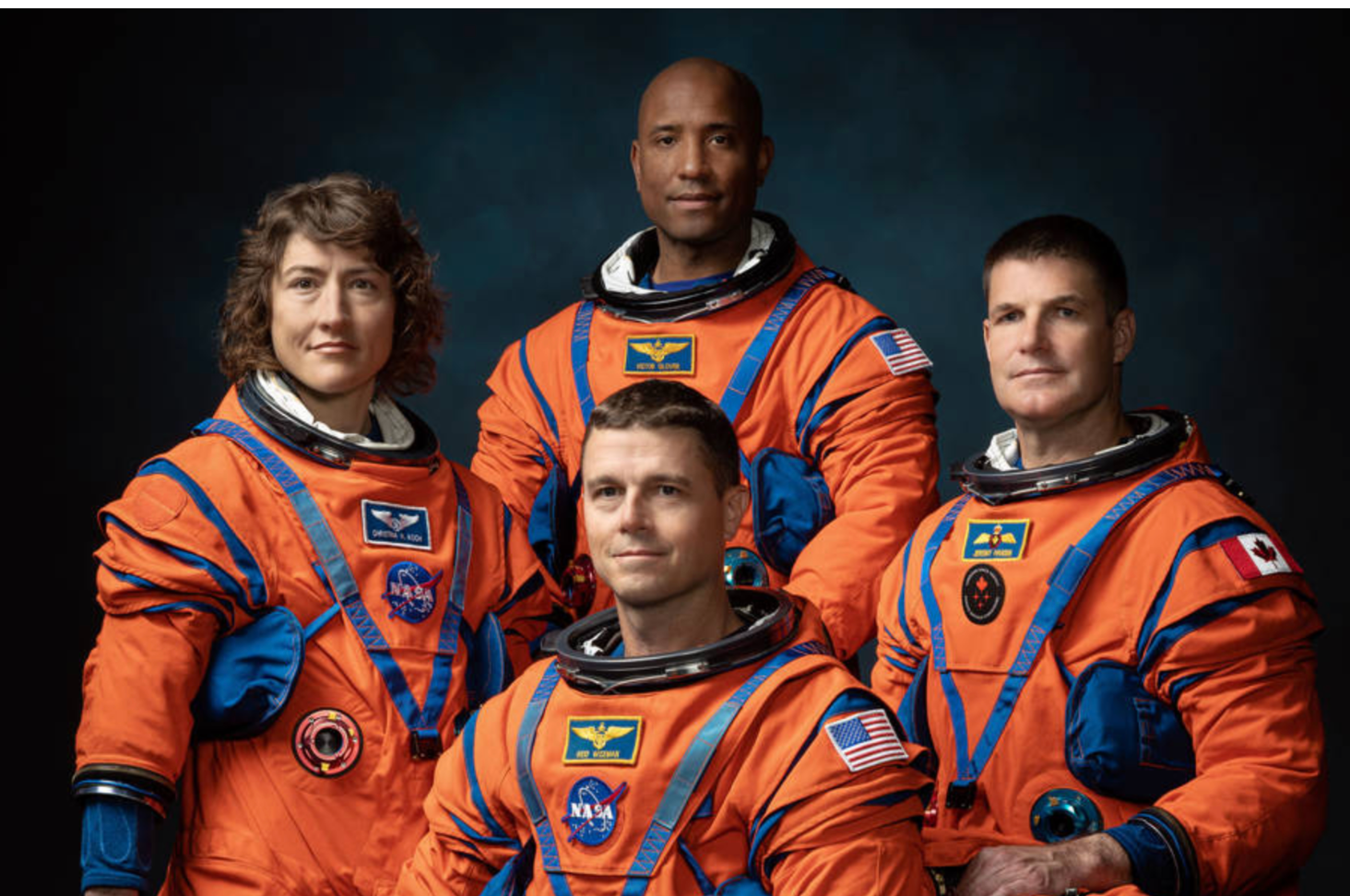
NASA’s giant new moon rocket, Artemis II, moved to the launch pad Jan. 17, in preparation for astronauts’ first fly-around the moon in more than half a century. The out-and-back trip could blast off as early as February.
The trip will send astronauts farther than any crew has traveled. Last spring we visited with the pilot of the mission, Victor Glover.

He was selected as an astronaut in 2013 and most recently served as pilot of the Crew-1 Dragon spacecraft which flew to the International Space Station. Here is our interview with NASA astronaut Victor Glover.
Gary Shorman: Welcome again to "Forward Ever: Leading in Challenging Times" with a special guest from Houston, astronaut Victor. Thanks for being on our program today.
Victor Glover: Thanks, Gary, great to be here. Thanks for having me.
Gary Shorman: You know, one of the things I know that we talk about on this program is leadership. You have walked in space four times. I believe you've been on the space station. You've lived up there for a while. What puts you in position?
Victor Glover: You know, from a leadership, from a career standpoint, to be in the astronaut program, I love talking about leadership. I love the subject and, well, I think a part of it would be following having a bunch of great leaders to work with and look up to.
Initially, when you're put into a leadership position, you can freestyle it, or you can mimic what you've seen. So I would say some great leaders do imitate.
I worked for some amazing people. My squadron commanders, I worked for John McCain for almost a year. Charlie Bolden, who ran NASA, but he was a Marine Corps general when I worked for him the first time, and so I think that's a big part of it, having some really amazing leaders to look up to in the beginning.
Gary Shorman: Were there some key moments in your career that kind of turned you towards being an astronaut?
Victor Glover: Key moments? Wow. I was in college, tutoring for a program, and loved working with kids, teaching engineering, and felt like I really had found my calling. I was considering the military and teaching at the time.
So my boss in that program, thinking she was going to help, really set the hook for being an educator, had me meet the executive director of this program.
I went up to the University of California office, and I walk in his office, and there's a constellation of our solar system and a rocket. And he sees me, leans back in his chair, he takes his glasses off and sets it on a book.
I shake his hand, and sit down, and he taps on that book. And he says, you see that right there? That's how I live my dreams of space exploration and flying. And he says, You have a chance to go fly in the Navy. Go do it, and if anything else, it'll make you a better educator.
That conversation, which was that quick, really turned my thinking. I've always loved education and the impact we can have on young people, but that really helped me get comfortable with the idea of going and starting this Navy journey, which, you know, lots of other decisions on the way, but that was the big one, whether or not to leave college and go be an educator or to go serve in the military.
Gary Shorman: In our story, you talk to students about that. I'm sure you make those choices, make those things that can change your life. You've done that.
You had a chance to be at the space station, walk in space. Let's talk a little bit about that. What did it feel like to step outside the spaceship and just go shooting? I see space right there that has to be a breathtaking experience.
Victor Glover: That is it? It is breathtaking because you don't know what it's going to feel like when you first get out there. The advice I received that really just kept repeating in my head was, "Keep your world small."
One of my classmates said to me, and so I just focused on right what was in front of my face, my hands and the handrail, where I'm going next. And so it took me about three hours before I felt like, OK.
I kind of got the hang of this. I'm going to start looking around and maybe taking some pictures. Actually, on my first spacewalk, I did not take a single picture. There were no selfies to be taken on. it, but it was busy.
I'll tell you, that's what it is. You're busy. When you're outside, there's a lot to be done, and it all requires intense focus.
I wrestled in college, and I think space walking has a lot in common with wrestling, even though it may be physical in a different way. It's very physical. It's very three-dimensional.
Your success requires you to integrate the three dimensions and to think about what's coming next. And that's very true in wrestling and space walks. It's so challenging. It's busy physically and mentally.
But most importantly, you're working with a team. And that team, Mike Hopkins, who had been out on a spacewalk before, and led our first one, the first one I went on, and also the ground team, they all helped to make that possible.
But that first moment when you look out, and you can see that for real, there are just no words to describe it. We train in a pool where you can see the bottom of the pool. When you look out, and it's 250 miles straight down, you go, "Wow! this is amazing and special. But also, what am I doing?"
Gary Shorman: Letting go to actually float would have to be one of those experiences that you can think about, and I can say, "Boy, that'd be hard to do." But letting go when you're out there, and you see that space out there, that's amazing. What did it feel like when you were named to be on the Artemis mission?
Victor Glover: Ah, wow. It's interesting, because people ask about the excitement, and excitement is a part of it. But the professionals who do what I do, understand the risks associated with this.
There's a lot of software, a lot of pieces and parts to this, hardware, lots of people. This is made all over the country, in all 50 states of the Union, and then also parts overseas.
And it all has to work flawlessly the first time for the duration of the mission.
So we understand the risk. And so I would say the overriding feeling was, first of all shocked, because I didn't expect to be on this mission, so I was a little shocked. But then also, I know focus isn't a feeling, but the seriousness, that's my overriding feeling, was the seriousness of this.
This means a lot for our country, for our agency, for our Artemis Accords, international partners, and it's risky. My family is going to have to go on this journey with me. We have a lot to get done in the next couple of years. And so, yeah, profundity, if it's a if that's an emotion, it was profundity.
Gary Shorman: If you look at 50 years since we've had a mission like this, and you'll be the first one to head to the moon, there's more to it than just circling the moon, though. Tell us a little bit more about the long-term plans for the Artemis mission.
Victor Glover: Artemis is our generation's deep-space exploration program. It's not just the Moon Program. We're going to make sure this Orion capsule is safe for humans to fly, so that we can fly it to eventually dock to a lunar lander.
That will get us to the surface of the moon, or to a gateway space station that's orbiting the moon. Both of those things are going to enable future technologies and future techniques and future teams to go beyond the moon on to Mars.
And continue to understand, maybe, how the Earth looked in its past, or where we may be headed in the future, if we don't take better care of our planet.
So the Artemis program is a big campaign. The moon is just one destination, and that's our mission. Our mission is to do the free return trajectory around the moon, but really to test out Orion as one big step on this journey that's going to eventually get humans to Mars.
Gary Shorman: Orion is your spaceship, and you'll be the pilot of that as you approach the moon and circle the moon. What are you going to be looking for?
Victor Glover: Oh, wow. So there's a potential. The region of the moon, what we would call the Western Hemisphere, looking at it from Earth on the far side. That part has not been completely seen by human eyes, and I just learned that recently.
So the fact that there's a potential for us to see something that's never been seen before, that's amazing.
But no matter what, even if it's completely dark, to look out the window of the spacecraft and to look at the moon in the foreground, and then see the Earth in the background, in the distance, a quarter of a million miles away, with my crewmates, Reed, Cristina, and Jeremy. I don't know what that's going to feel like, but I'm looking forward to that. That's going to be amazing.
Gary Shorman: I hope you send us pictures back, Victor. I know you're short on time because you have a lot of people and you have a lot of training to do. That has to be intense training, because there are so many moving parts, as you say, that intensity, that focus it takes. How many hours a day do you train?
Victor Glover: So we will start training next month, and I imagine it's going to be chock full. I think they're going to schedule our days full. And you know, while some of it will be technical training, some of it will be continuing to engage the public, like we are now.
But also, we will be engaging the team that's developing the hardware or building hardware and software, and thanking them for their hard work and letting them know how much we count on their technical expertise. And so they're going to keep us busy. Gary, you can be best believe we'll have some full days until launch.
Gary Shorman: I can't wait to see how this all develops. Look forward to it, and maybe again later on, once you're back, get a chance to follow up on that. But Victor, thanks for being on our program.