


By CRISTINA JANNEY
Hays Post
Fort Hays State University President Tisa Mason said Friday the university is still exploring all options for the Sternberg Museum of Natural History.
Although Mason said the decision has been made to keep the museum open, all options are on the table for its future.
Three groups have been organized to search for ways to make the Sternberg sustainable.
Those groups include the FHSU Foundation, the university's fundraising arm; a group led by Provost Jill Arensdorf and Werth College Dean Mark Arant that includes the Sternberg director and staff to evaluate the collections and academics; and a community group led by Mason to pursue partnerships and museum business models.
The community group includes Sandy Jacobs, Hays city commissioner; Gary Shorman, president of the Robert and Pat Schmidt Foundation and chairman of the board of Eagle Media; Doug Williams, Grow Hays executive director; and Rick and Gail Kuehl, community members.
Mason reiterated Friday that her Sept. 29 decision to initially close the museum in December was driven by a $2.4 million state budget cut. She said closing the museum, which has a $1.3 million annual budget and an $850,000 subsidy from the university, was the only way she could see of closing the budget gap without affecting academic programs or student services.
“I never wanted to cut Sternberg,” Mason said. “I just didn't know how to get to my $1 million of the $2.4 million without doing it, because it wasn't producing credit hours. It wasn't graduating students.
“If I didn't take it from Sternberg, I was going to have to start cutting academic and student support services, and I didn't want to do that, so I felt forced into the Sternberg corner.”
Early stages of planning
Mason said the three groups are very early in their exploration.
She estimated that determining the museum's future would be a one- to two-year process.
Donations from community members, along with up to a $1 million matching grant from the Schmidt Foundation, have bought the university and the museum more time, Mason said.
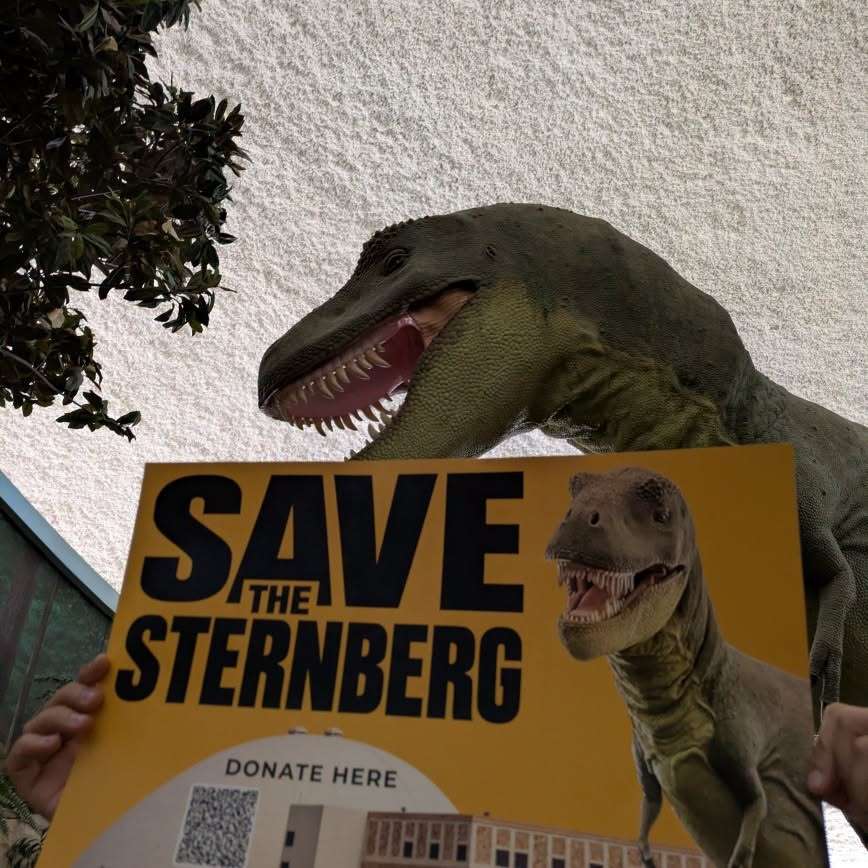
As of Tuesday afternoon, the Save the Sternberg fund had raised $1,436,558, with $281,721 in matching funds remaining from the Schmidt Foundation.
You can donate to the fund here.
“Although this is painful, I still think it was the right decision in context,” Mason said. “The fact that the community stepped up and helped, and a big thank you to the Schmidt Foundation for getting us to that million dollars to buy the time to rethink sustainability, has been a true blessing and a relief to me as well.
“Because I never wanted to close it. I had to solve the financial problem, and so now we're trying to solve the financial problem collectively,” she said.
Museum cuts likely
Mason discussed some of the avenues the groups have investigated as they look to the museum's next chapter.
Mason said one of her concerns, as she first considered closing the museum, was salaries. The museum had more than $900,000 in salaries in FY26.
“That's why part of that million dollars that we have to find in staff salaries is going to definitely result in a shrinkage of the staff,” Mason said.
In a Nov. 12 interview, Museum Director Reese Barrick said the museum’s staff was bare-bones.
He said no staff members had announced resignations at that point.
Mason said one way to scale back staffing would be to further reduce the number of live animals the museum houses.
Barrick said in his interview that the live-animal budget, excluding salaries, was about $14,000 annually. He said that was mostly for food. He said that budget did not include adding the three new mammals to the collection or the exit of the rattlesnakes, boa, helimonster and skink, which have already been rehomed.
Sternberg scientific collections
Mason said even when the plan was to close the museum to the public, her intent had always been for museum staff to take up to a year to evaluate and catalog the museum’s scientific collections to determine its legal and ethical obligations.
“We weren't just going to go to some kind of auction and sell things off and have them in people's homes,” Mason said. “It was going to be a very, very thoughtful process.”
She said sale of non-scientifically important items had not been ruled out. However, she said it was her hope that, had the museum closed, scientific collections would have been rehomed to another museum or museum(s) so they could continue to be studied and viewed by the public.
The museum staff is still cataloging and analyzing its collections to determine the best, most cost-effective way to maintain them.
In addition to fossil collections, the museum has collections of mammal skins, preserved birds, insects, fish and amphibians.
According to a previous news release, Sternberg has 3 million specimens in its collections.
Strengthening academics
Eric Grospitch, FHSU senior adviser for executive operations, said the three groups evaluating Sternberg’s future are looking at the institution from two different lenses. One is the forward-facing public museum for families and tourists. The other is the museum's scientific and academic aspects and collections.
Mason said she would like to strengthen academic programs through the museum and add partnerships with other FHSU programs, universities and museums.
“It used to be much stronger in terms of the academic work that was going on, so that went into my decision as well,” Mason said of her initial decision to close the museum.
She added, “Faculty have changed because faculty have retired, and new faculty came in with different specific interest areas. Those connections have shifted over time.
“We felt like those academic areas of interest and student interest, though nominal to our $2.4 million cut, could be sustained in other ways, so faculty and students would not lose out,” Mason said.
In his Nov. 12 interview, Barrick also said he would like to see more academic partnerships between the museum and other FHSU programs, including science, history and art.
Mason noted the newly renovated Tebo Library has expanded its programming and is offering its space for a wide variety of campus and community activities, with the dean noting a 300 percent increase in use since it reopened.
“I just think that we're learning about a lot of things, museums that are really reinventing themselves,” Mason said.
Building and operations
Although Mason said she would not turn away any viable options, she said she thought it was unlikely that Sternberg would move from its current location.
Hours could be cut, she said.
She said cutting hours could give staff more time to work on collections cataloging.
“I'm waiting for that decision in December, and we'll make an announcement before we close for the break,” she said.
Mason said she also thought changes might need to be made in user fees.
“I do think those ticket prices are going to have to go up, and things like that, but I want that to be the work of that committee, not me,” Mason said.
Funding partnerships
The group, which includes community members, is looking at other models for city and public museums. Mason said they are exploring grants and public and private partnerships.
Although there has been no formal request, Mason said the group has discussed city or county tax support through a sales tax or transient guest tax.
An additional sales tax in either the city or county would have to be approved through a public vote. Mason acknowledged it could be difficult to pass any measure that would require higher taxes.
Hays’ current sales tax rate is 9.25%, with some special taxing zones being higher.
Mason said she wanted to keep the initial community group working on the future vision for Sternberg small. That group does not currently include anyone from the Hays Convention and Visitors Bureau, Hays Chamber or Ellis County government.
The museum director is not a member of the community group led by Mason, which Mason described as a necessary separation to avoid a conflict of interest.
Self-sustaining?
Mason said ideally the Sternberg would be self-sustaining.
“I don't know how realistic that is, but that is the ideal world because our funding is so tight,” she said.
Mason reiterated some of what she told the Legislative Budget Committee on Oct. 27.
She said FHSU is receiving proportionally less funding per student than the other regional Regents universities.
“We are substantially underfunded if you look at FTE as a part of the formula,” she said.
She added, “I just know that when we get down to cutting into the muscle of Fort Hays with this budget cut, as we're already so lean, the only place I could go to find that million dollars was Sternberg.”
She said community members can reach out to their local legislators about restoring funding to FHSU.
“This is not a Sternberg problem. It is a budget problem from the state, and that's what I tried to make clear,” Mason said.
The research groups for Sternberg 2.0 are also looking at possible federal funding options.
Based on the amount of funds raised now, the Sternberg will be open through spring.
However, Mason said what that presence will look like in the future is still undetermined.
“There will be a Sternberg presence,” she said.
Based on the money raised, she said, the museum should meet its budget deficit for the fiscal year 2028.
“There's going to have to be some scaling down to be sustainable,” Mason said.