


By CRISTINA JANNEY
Hays Post
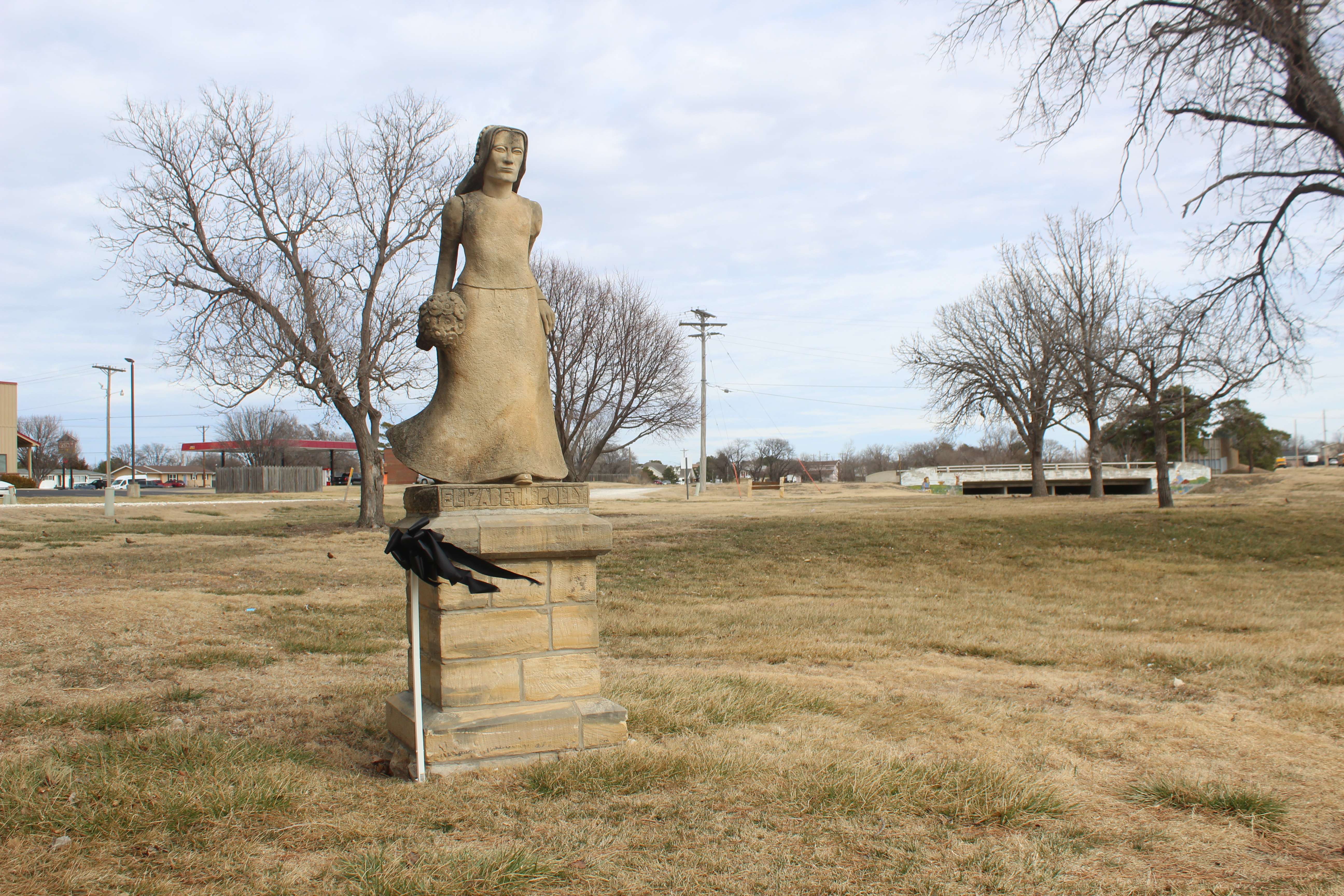
The iconic Blue Light Lady limestone sculpture created by Pete Felten is set to be moved from its location at 26th and Indian Trail to Historic Fort Hays.
The Elizabeth Polly Blue Light Lady statue sits in green space west of Indian Trail, south of Dairy Queen and east of Centennial Towers in Hays.
The statue has resided there since 1982. The Hays Arts Council spearheaded the statue's placement at the park.
Although there is a small playground area on the east side of Indian Trail, the statue sits alone and is often overlooked by visitors and even residents of Hays.
The Society of Friends of Historic Fort Hays has raised funds to move the statue to a site at the historic fort, where it will be more visible and can be used to tell Elizabeth Polly's story.
Elizabeth Polly was born in 1843. Her husband was a hospital steward at Fort Hays. She tended to cholera victims at Fort Hays during an outbreak in 1867. She contracted cholera and died that same year.
"She was a courageous, young woman who sacrificed her life nursing soldiers suffering from cholera. While she has become a legend through her ghostly hauntings, her actual life is even more inspiring.
"We want our visitors, adults and children, to leave admiring the woman. Our history is full of sacrifice, which provides us with enduring lessons of strength and perseverance," the Friends of the Fort said.
In addition to the statue, the Friends of the Historic Fort want to place a plaque on a pillar adjacent to it that tells the stories of Polly and Felten.
The fort is also home to Felten's Monarch of the Plains bison sculpture. Felten died on Feb. 4. Read more on Felten's life and work HERE.
Adam Conkey, Historic Fort Hays site administrator, said the fort is still in the planning and fundraising stages of the move.
The fort would like to locate the statue near the hospital site. Conkey said the hospital did not exist on that site when Polly was tending the sick. She would likely have cared for soldiers housed in hospital tents.
Polly was buried at the base of Sentinel Hill, but her remains were moved to the top of the hill, said Marla Matkin of Friends of the Fort, who also portrays Polly during reenactments.
"She knew the risk she took in nursing these young men," Matkin said, "but she felt she was providing a very needed service, and she was."
Polly was given a full military funeral service because of her dedication to caring for the soldiers, Matkin said.
There is a monument marking Polly's grave on Sentinel Hill, but since it is on private property, permission from the landowner would be required to visit.
Conkey said some of the Polly story has been told through family legend, and it's difficult to know what is accurate.
According to legend, Poly was buried in a blue dress. Locals have said for generations that they have seen her ghost, cloaked in a misty blue light, wandering the area.
The Friends of the Fort hope to have the statue moved in April and have a formal unveiling of the sculpture at its new site on Sept. 26, Matkin said. 80 Proof Alice will perform at the event.
The Friends of the Fort also has upcoming monthly events, as well as a July 4 celebration to honor the 250th anniversary of the signing of the Declaration of Independence.
The fort's period baseball team will play.
This year is also the 150th anniversary of the Battle of the Little Bighorn. Reinforcements from Fort Hays were called north to serve after the battle, Matkin said.
George Custer, who spent time at Fort Hays, was killed at the Battle of the Little Bighorn, during which Lakota Sioux, Northern Cheyenne, and Arapaho tribes engaged the 7th Cavalry Regiment of the U.S. Army.
If you would like to donate to the Elizabeth Polly statue project, write a check to the Society of Friends of Historic Fort Hays, with "Elizabeth Polly statue" in the subject line, and mail it to Historic Fort Hays at 1472 U.S. 183 Alternate, Hays, KS 67601.
Matkin said the Friends of the Fort is always looking for more volunteers. If you are interested, you can visit the fort and talk with Conkey.
"It is a commemorative year," Matkin said. "It's a great time to see some of the stuff and learn some history and maybe get involved and become a part of it."