



Submitted by Karen Madorin
Recently, we took a 4-day road trip into a parched region of the Great Plains with even fewer trees than Northwest Kansas has. Acre upon acre suffers severe drought that’s morphed pastures into tinder awaiting dry-lightning strikes. Driving through this essentially treeless land, we commented on challenges farmers and ranchers face to keep operations solvent. Unexpectedly, a stunted tree interrupted the flat horizon line, requiring a second then third look to assure us we weren’t hallucinating.
Such sporadic visions appear between 20 to hundred miles apart. Despite their diminutive size, each housed oversize nests cobbled from twigs and small branches. I wish I had photographed each one so a nest expert might tell me what prairie creature hatched hope in such a challenging nursery. Silly me, during a 600-mile journey where I noted 8 such rare examples, I took one photo.
The first tree I saw near Forgan, Oklahoma, housed a standard owl or hawk nest with its shallow bowl-like profile loosely constructed of available materials. Young birds had fledged so I had no hint of the exact species that considered this lonely neighborhood home. If it were an owl or a hawk, they didn’t face serious competition for available rodents. Dry conditions limited cottontail populations because I saw no signs of bunny remains on miles of traffic-starved highway. That particular tree grew far from a farmstead so occupants couldn’t count on barn cats to round out their diet. We did see meadow and horned larks and a few lark buntings that may have supplied necessary protein.
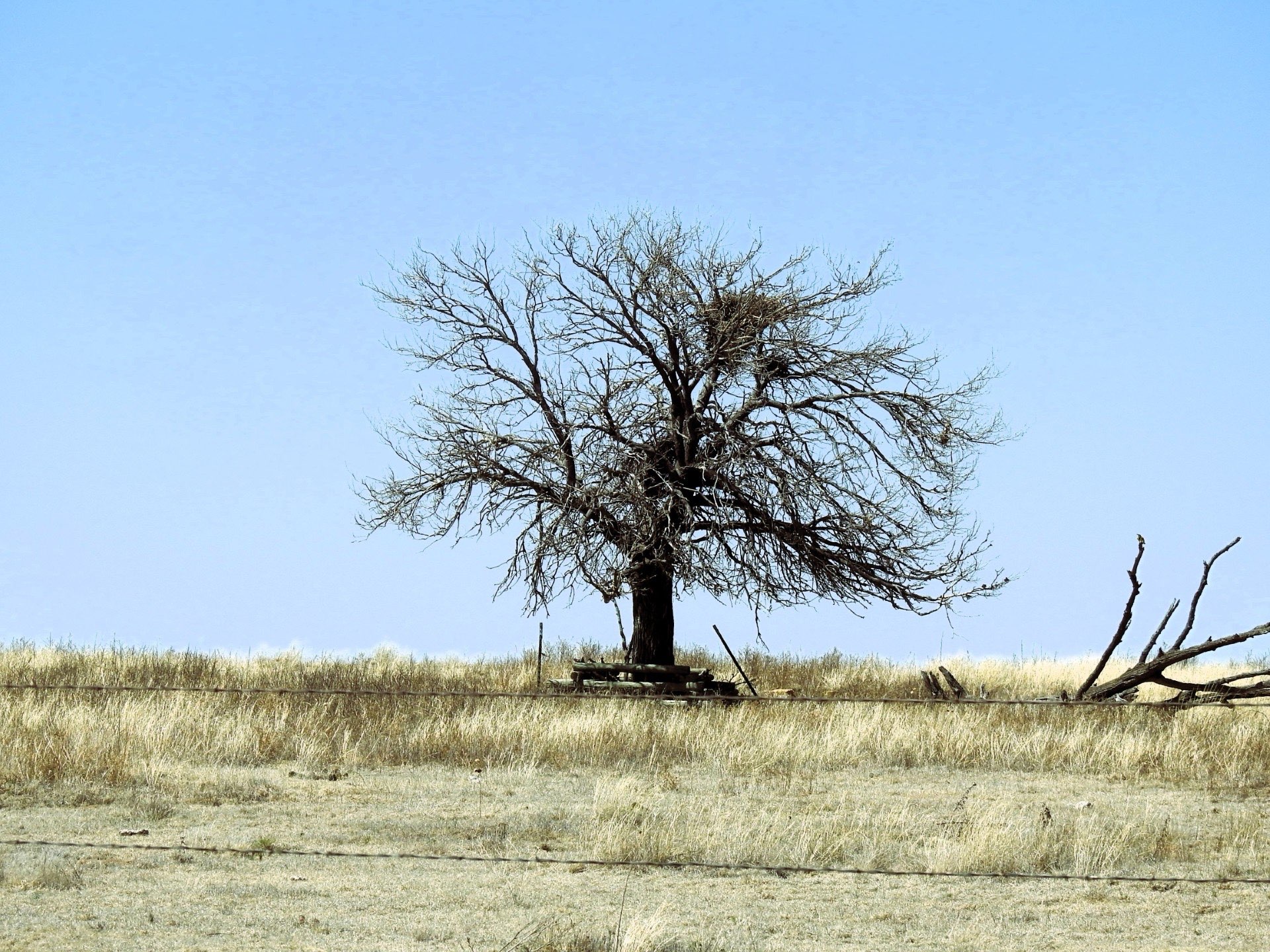
The next few such trees and nests shared similar shapes and distances apart. Again, farmsteads were out of sight. You’d have to see yard lights at night in order to find them. How crazy that a bird pair flying over zeroed in on the only tree in that county and scrounged enough material to construct a passable nest.
In the corner of the Oklahoma Panhandle, bordering Colorado and New Mexico, I spied a weird nest. It was huge and long, like an inflated cornucopia formed of cobbled sticks and grass. Again, occupants already fledged, leaving no clue to what raised young there.
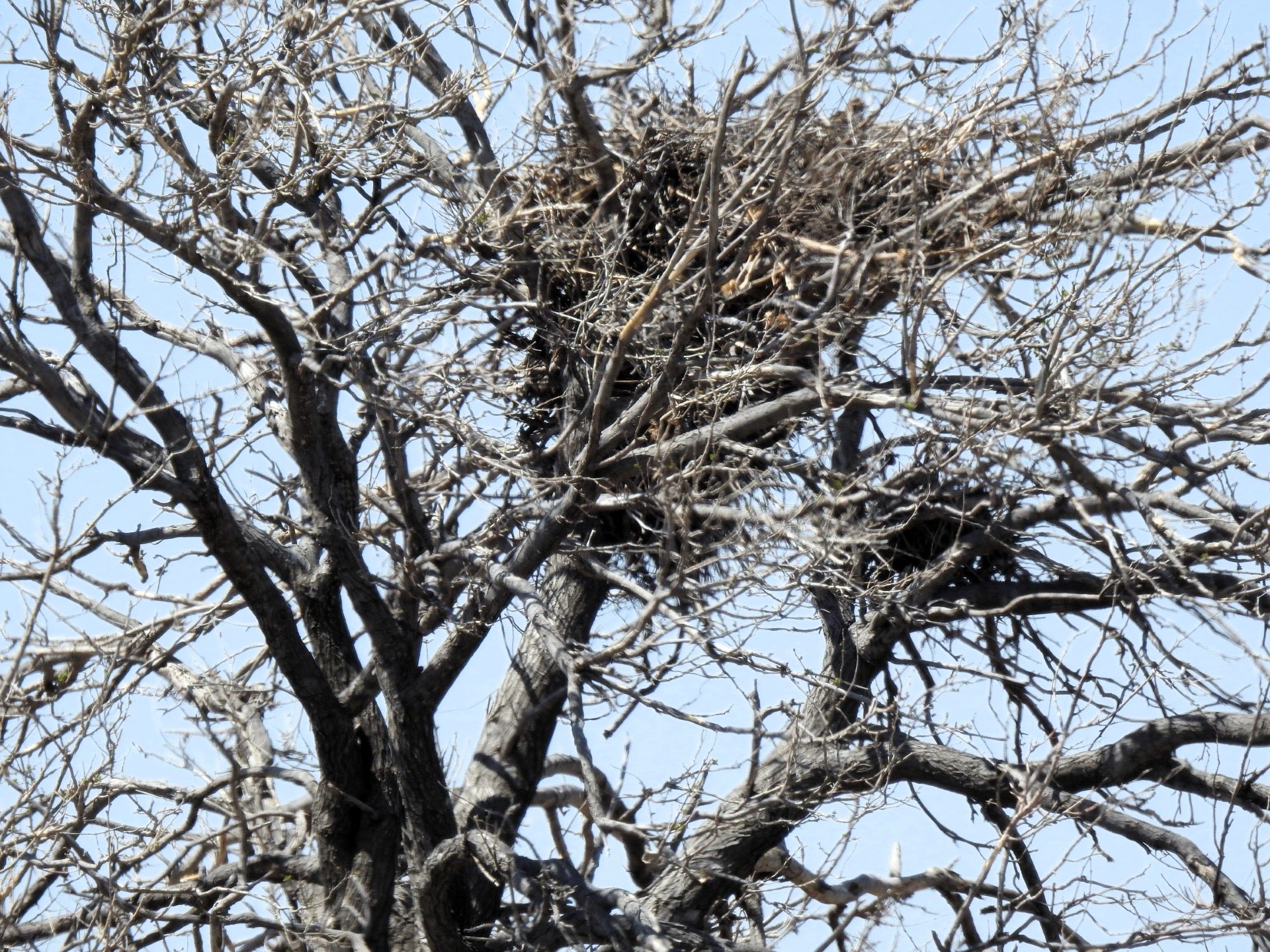
By the end of our trip, we’d wound our way past volcano fields and craggy mesas into Baca County Colorado where trees still remained in short supply. State lines might delineate tax status and license plate design but environment dictated pasture quality and quantities of forbs and trees. Miles from any town or homestead while seeking the road to Picture Canyon, I spied another long, funnel shaped nest that took up half the body of the only drought-stunted tree in miles. Finally, I took a picture.
I hoped zooming in would offer details regarding who raised a family there. Nope. Up close, it looked similar to packrat nests I found at the base of cottonwoods when we lived along Big Creek. When I researched whether such rodents nest in trees, multiple sources responded rarely.