


By BILL FIANDER
Insight Kansas
To rule is easy, to govern difficult.” (Goethe)
On August 4th, Kansans have a watershed moment to narrow their party’s field for governor. Issues within the campaigns are well documented like property taxes, school funding, job creation, affordability, Kansas values, etc.
But with voters focused on issues or personality, understanding how candidates would govern may be even more important in the end. After all, governing is the job. Yet we hear so little about it in campaigns.
It’s been said, you campaign with poetry and govern with prose. If so, how do we get a better feel for a candidate’s prose while being romanticized with the so-called poetry of campaign ads and mailers?
Framers of state constitutions called their chief executive “governor” as derived from an ancient Greek verb (govern) meaning “to steer” or “to pilot”. It was a curious deviation by Greek city-state democracies from the tyrannical archetypes of the day that imposed their will on subjects. Despots didn’t merely steer the state’s ship but controlled every facet of government through fear and violence.
Greek philosophers like Plato weren’t advocating for power-hungry despots or kings with self-indulgent appetites. Instead, they looked for tempered philosopher-kings who did not strive for power but could wisely navigate choppy political and economic waters to serve the collective good.
“…the State in which the rulers are most reluctant to govern is always the best and most quietly governed, and the State in which they are most eager, the worst.” (The Republic)
But in the modern administrative state of today, executing and enforcing the sheer amount of state and federal legislation required more than piloting. It requires strong co-piloting.
Good governance today is really shared governance; collaborating with federal, state, local, private, and non-government sectors. It forces decision-making into the light so we can better see the efficacy of tax dollars. With transparency comes the open flow of information, bigger tent participation, consensus building, minimized corruption, data-framed solutions, and accountability.
Today’s minted governor must be a mash-up of technocrat and bridgebuilder who steers for the collective good (outcomes > political power). In Governor Kelly’s era, less sexy things like the Kansas Infrastructure Hub, modernizing the unemployment insurance system, and inclusive planning for a water-secure future are good governance gems.
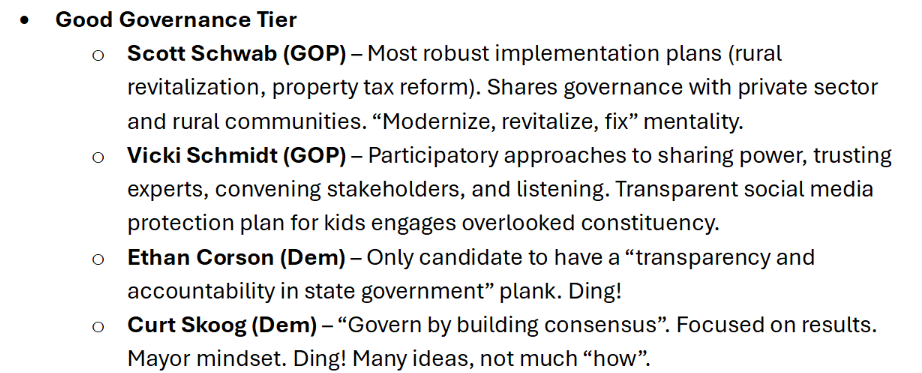
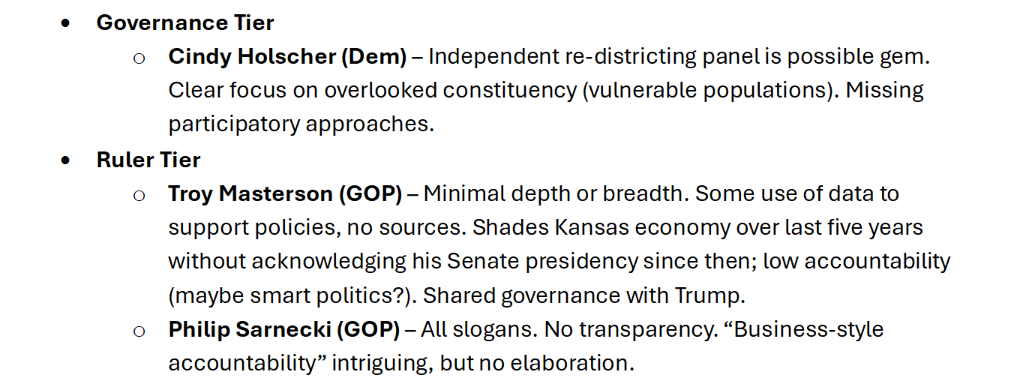
As for potential next governors, how well did their campaign websites give us clues of future good governance?
Bill Fiander is a former city planning director teaching university-level courses in Kansas covering state/local government, public administration, and planning.