


By KAREN MADORIN
Sometimes you look at critters and question evolution.
Australian kangaroos and platypus come to mind along with other Down Under animal adaptations while the Americas have their own intriguing beasts.
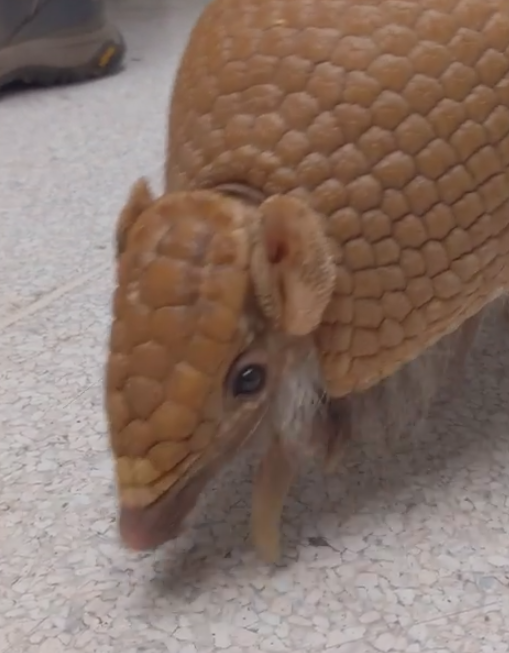
One is often seen squashed on Texas, Oklahoma, and now Kansas interstates—the armadillo. Recently, I spied one flattened on I-70 in Trego County. Soon after, I read about Ellis police relocating one from a local yard.
Like African killer bees traveling from South America, armadillos march north seeking to expand territory. These four-legged immigrants must not comprehend Kansas winters, or they’d keep their hairy scutes in warmer climates.
Perhaps they should reconsider any migrating since farmers and ranchers love grub-digging armadillos about as much as they love prairie dogs. Despite their disfavor with agricultural folk, these prehistoric beasties won my heart years ago when I discovered one’s ability to leap vertically six feet from a flat-footed position in direct contact with Mother Earth.
This introduction occurred as I drove an isolated Oklahoma highway late one night. A bizarre creature possessing a conical snout and ovoid body on short legs with long claws waddled before me. Alien invasion popped into my mind. An Oklahoma newcomer, I’d seen armadillos only in magazines, so the vision before me compelled me to drive at a slow crawl.
For lack of definitive gender ID, we’ll refer to this as “he.” Thinking he would hurriedly cross, the varmint instead stopped like he was stuck in tar. Preferring not to squash him, I too, halted.
Shining my brights enhanced the full effect of his antics. That seemingly stuck armadillo leapt vertically—rising 3 feet above the hood of my '66 Plymouth. Eyeballs reflecting headlights heightened this eerie vision. Modeling a football-shaped body, his four-clawed feet shot out at 90-degree angles. He hovered like a basketball player stretching for a tough lay-up while I searched for alien spaceships.
Under different circumstances Mr. Armadillo would have finished life as road kill. Because he surprised me somewhere I could ogle a strange creature whose jump startled both of us, his species gained a devoted fan.
Every armadillo I’ve seen since revives that memory. Mr. Been Around Since Prehistoric Times charmed me and began a lifelong love affair.
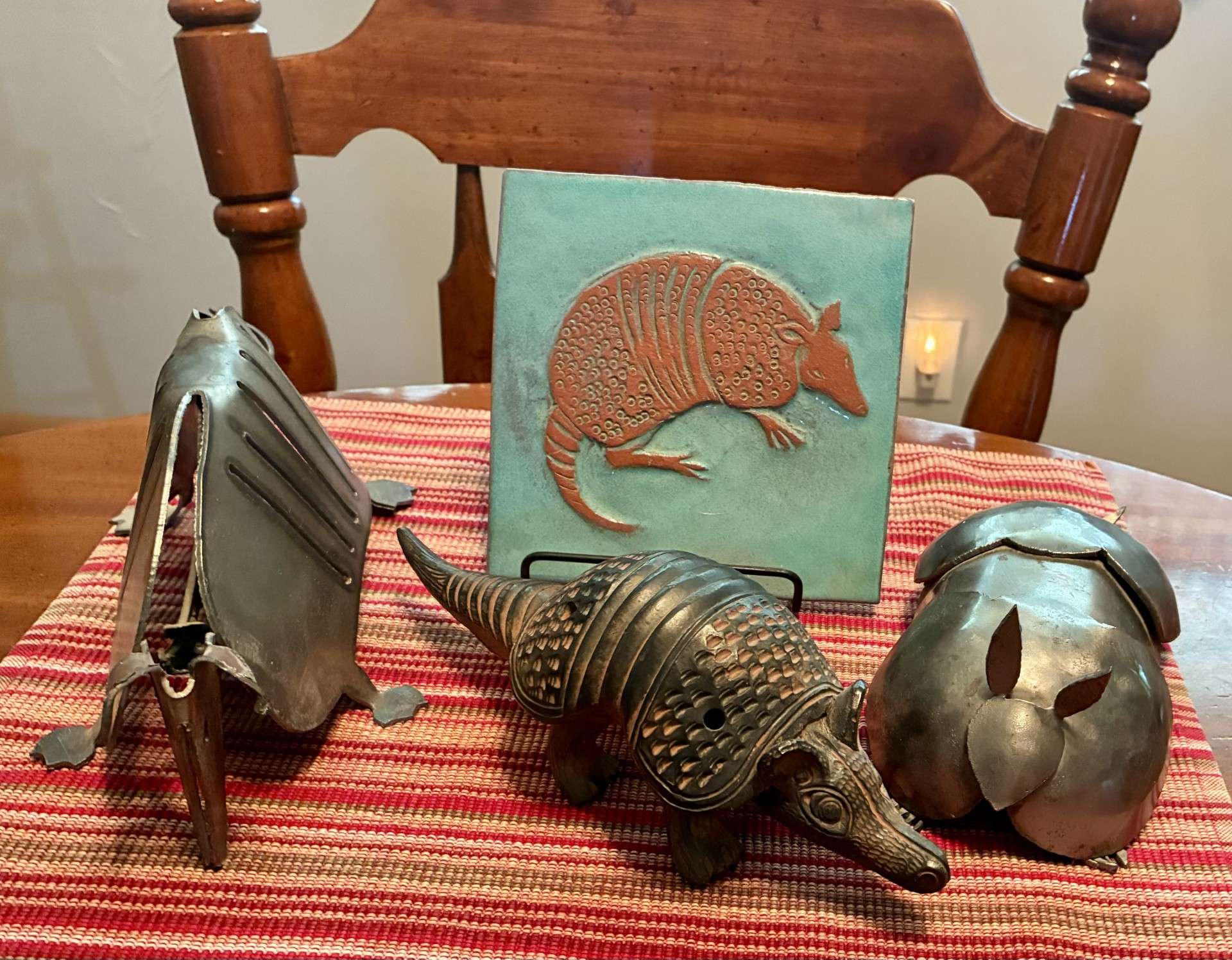
Since that first meeting, I’ve collected over 40 armadillo statues. Visitors spy our curio cabinet to ask what’s that, opening doors to explain odd facts about this New World invader.
Nine-banded armadillos living in the southern United States share unique characteristics enabling them to survive their slow march toward Canada. Besides the physical adaptation of hairy scutes protecting armadillo soft parts and their astounding vertical jumps, they are reproductive marvels.
Similar to some marsupials, female armadillos delay development of fertilized eggs until optimal conditions exist. Nine-banded varieties almost always bear identical quadruplets. According to James Michener’s book Texas, pregnant females adjust hormones to determine the gender they bear based on species survival needs.
Despite rancher opinions about armadillos, I like any critter that scares predators with a vertical jump and a funny face. I also like a beast that can choose its offsprings’ gender as well as when it delivers those babies.
My bucket list wants another chance to watch an armadillo levitate and hover but not on Interstate. I want us both to survive, startled but unharmed.
Karen Madorin is a retired teacher, writer, photographer, outdoors lover, and sixth-generation Kansan.