


By TONY GUERRERO
Hays Post
Local Republican legislators discussed several issues regarding education and a bill impacting transgender people.
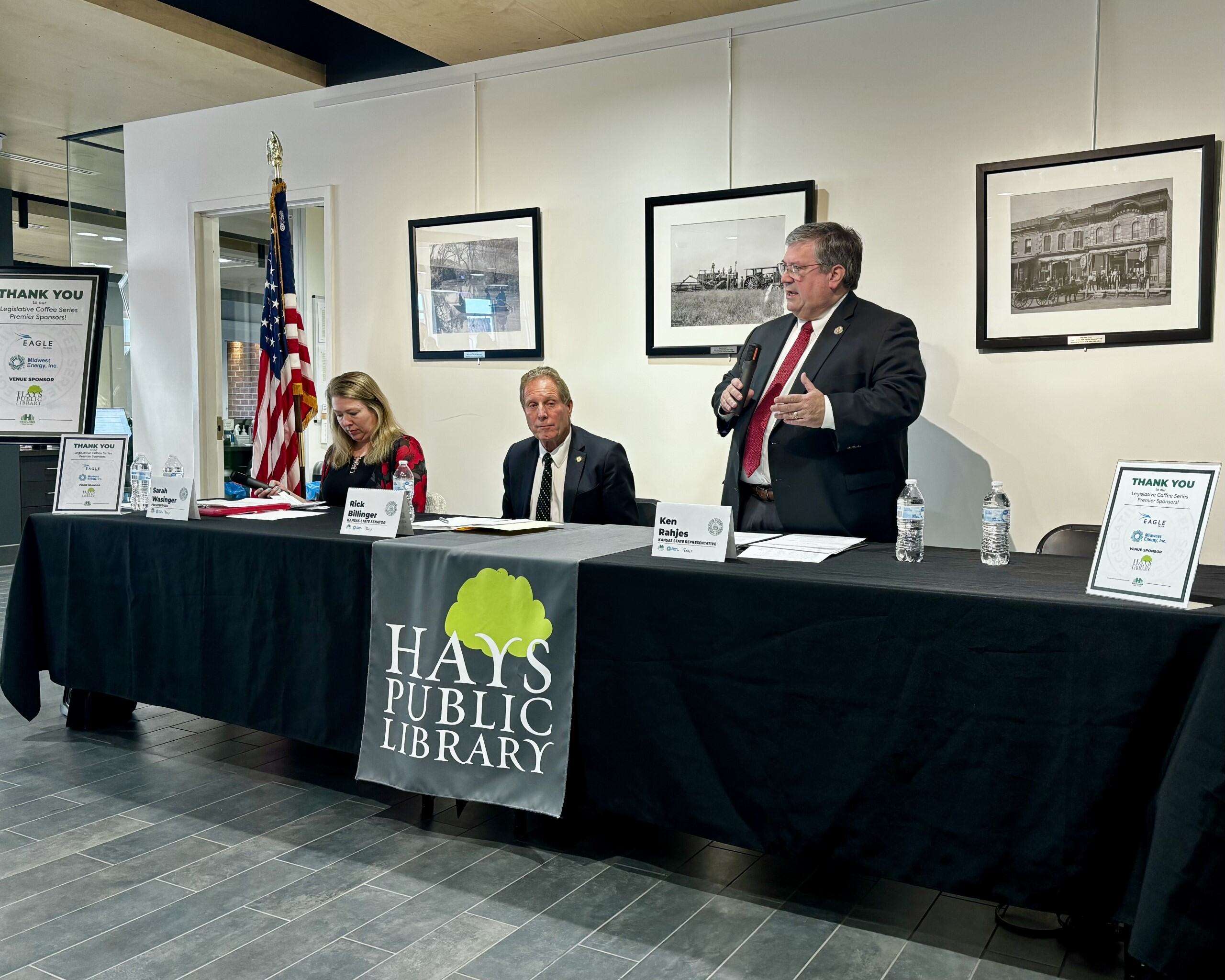
Kansas Sen. Rick Billinger, R-Goodland, and Rep. Ken Rahjes, R-Agra, spoke to attendees at the Hays Public Library. Rep. Barb Wasinger, R-Hays, was absent due to family matters.
K-12 special education funding
Billinger said special education is important, but acknowledged it is not fully funded. He said lawmakers are considering adding between $5 million and $10 million this year, which would push total funding above $611 million.
"I don't want to blame anyone in particular, but the federal government is not putting in their percentage. The state's putting in a larger percentage than the feds are. Our funding is limited," Billinger said.
Billinger said $26.7 million has been budgeted to increase wages for individuals with intellectual and developmental disabilities.
Proposal to restrict school lunches
Billinger was asked whether he would oppose a proposal to limit food assistance for students based on their parents’ income and how it could affect USD 489, which provides free meals to students, including during the summer.
Billinger said lawmakers do not want children to go hungry and that districts such as USD 489 may continue providing meals if they have the resources available.
Cutting higher education funding and its impact on Fort Hays State University
The panel was asked who benefits from cutting higher education appropriations, referencing a House bill and a Senate bill, given that it disproportionately affects FHSU.
Billinger said deficit reduction is necessary, noting the state spent $705 million more than it collected last year.
"Naturally, the biggest part of our budget is K-12 education, higher education and human services. That's 86% of the budget. When you're looking at reducing things, that's the way it works," he said.
Billinger said two-year community and technical colleges have received an additional $75 million over the past six years. He added that the Senate’s version of the bill does not reduce funding for FHSU, while the House bill does cut funding intended to offset the university’s lower per-student funding.
Rahjes said some House members believe taxpayers benefit from the proposed cuts. He said he does not support underfunding higher education and that it could have negative economic impacts.
"I'm a past chair of higher ED. I was basically told to stay out of the way. If I got in the way, then what I advocated for would be made sure to be cut," Rahjes said.
DEI at universities
The panel was asked whether they oppose House Bill 2428, which would require the Board of Regents to establish curricula so that students are not required to take DEI or critical race theory-related courses at postsecondary institutions.
Billinger said he was not familiar with the bill. Rahjes said, "I'm sure I probably voted for 2428."
An attendee said Rahjes should be fully aware of the measures he votes on and that it is inappropriate to support legislation he does not understand or recall.
Arguments between Rahjes and the attendee followed.
"I think what is happening is it's giving the opportunity for teachers to teach, but also for students to make sure they're not bullied one way or the other. It could be reverse bullying," Rahjes said.
The bill would also require universities to incorporate specific programs for freshmen on free expression and free speech.
Institutions would be required to post materials related to gender identity, DEI and critical race theory on their websites for public access.
Driver's license bill and voting
The panel was asked why Senate Bill 244, which invalidates and reissues driver's licenses and birth certificates to reflect a person's biological sex at birth when necessary, took effect immediately without allowing time for individuals to obtain updated identification.
"As far as that taking effect immediately, that may have been a little bit of an oversight because I don't think that was the intent," Billinger said.
Rahjes said enforcement has varied locally and that the bill followed the standard legislative process. The panel was also asked why a driver’s license is required for voting.
Rahjes said if county clerks received proper training, proposed bills such as requiring a driver's license would not be needed.
An attendee responded, saying training county clerks has nothing to do with the Senate Bill 244 and criticized it as unconstitutional.
The bill also requires public buildings to designate public restrooms and locker rooms for use by only one sex. The bill defines gender as biological sex at birth for purposes of state law and establishes criminal and civil penalties for violation.
Transgender Kansans
The panel was asked how they would encourage transgender residents in their districts to stay in Kansas after the passage of Senate Bill 244.
"I think people are going to live where they want to live, and I think policy does have something to do with that," Billinger said.
"You're welcome to live where you want," Rahjes said. "We have a transgender legislator. They're in my committee. I treat them with the same respect I do anyone."
Rahjes said the bill followed the legislative process, including debate, veto and override procedures. He acknowledged the issue is divisive and noted a pending lawsuit filed by two transgender men from Lawrence.
Capping property tax and reinvestment housing incentive districts
The panel was asked for their positions on a proposed 3% cap on property tax increases, with concerns that it represents state overreach and could harm local infrastructure.
Billinger said he voted in favor of the cap because he supports property tax relief. However, he doubts that the cap will achieve its intended purpose.
"We'll see what happens. We need to work on reducing property taxes, and our local county commissions are doing their best. They had the same type of increases in expenses at the county level as we do at the state level," he said.
Rahjes said he voted no because the Senate refused to bring a tax bill forward for consideration last year. In response, lawmakers voted no to "send a message."
Regarding Reinvestment Housing Incentive Districts, Rahjes said he does not yet have a clear answer on how programs like RHIDs would function if property taxes were eliminated.
"There are a couple of plans out there to eliminate property taxes altogether and go with either a luxury tax or a use tax. Programs that are directly tied to property taxes are going to have to be reviewed," he said.
Rahjes and Billinger highlighted a proposal from Sen. Michael Murphy, R-Sylvia, that would eliminate property taxes and replace the estimated $6.6 billion in revenue with a consumption tax.
"You'd still have the regular sales tax, but the way [Murphy] put the bill together, he used AI to come up with figures. I'm not sure if the figures are correct, but I like the concept," Billinger said. "If the numbers could be justified to work, I don't think I would mind paying a little extra on the consumption tax."
Deficit
The panel was asked whether the state has made commitments it may not be able to fulfill as lawmakers aim to reduce the deficit to about $200 million per year over the next three years. The overall goal was also questioned due to its high amount.
"Our commitment is that about 87% of our budget is between K-12 education, higher education and human services. If we have to have this amount of funding, we have to have it. No debate," Billinger said.
He also highlights revenue losses from eliminating the food sales tax and payments to the Panasonic project, which total around $120 million, as contributing to budget pressure.
Rahjes said waste, fraud and abuse in state spending are being examined.
"Overall, they'll continue to be a tightening, you'll continue to see a reduction, and probably see no new programs unless there's some way to take it somewhere else and pay for it. We'll see where the economy goes," he said.
The final Legislative Coffee is set for 8:30 a.m. on March 28 at the Hays Public Library, 1205 Main St.