


STACY CAMPBELL
Cottonwood Extension District
Once in a while we get asked, “how cold does it have to get to kill insects?” Perhaps it is important to understand why cold temperatures kill insects.
Insects are unlike mammals and birds because they must generate their own heat (called ectotherms). Insects die when they are exposed to temperatures below the melting point of their body fluids. If they want to survive winter, they must avoid freezing or tolerate freezing. Over time, insects have developed several strategies to survive cold temperatures and none of them involve wearing fleece.
Some insects just move into human structures in the fall and keep warm until spring. A common example are the multicolored Asian lady beetles aggregating on and in houses every year. Even if they are protected inside, they will likely die before spring if they don’t get food and water. Some insects also migrate to warmer climates to avoid freezing. A classic example is monarch butterflies moving from Canada to Mexico every year. Sounds pretty good about now!
A lot of our persistent insects in Kansas have to overwinter outside, and two strategies have evolved to survive extreme conditions: freeze avoidance and freeze tolerance. Freeze-avoidant insects keep body fluids liquid and freeze-tolerant insects can handle the formation of internal ice. Wait a minute, what? I know…either strategy seems impossible.
The main strategy for insects living in the northern hemisphere, where we can have cold temperatures for long periods of time, is freeze avoidance.
Freeze avoidance can be achieved a few ways.
Sometimes insects enter a “dry” hibernation by getting rid of all the food and water in their body. That way, ice can’t form inside the body and kill them. Water needs food or dust particles in order to crystallize; water can cool down to -42°C without freezing if particles are absent. Other insects have a super waxy coating on the exoskeleton that protects against ice formation on the body. Amazingly, some freeze-avoidant insects also produce cryoprotectants, such as glycerol and sugar, to reduce the lethal freezing temperature of the body. So yes, cryoprotectants act like the antifreeze in your car. I can’t make this stuff up!
Most insects living in the southern hemisphere, where the climate is more variable, employ freeze tolerance.
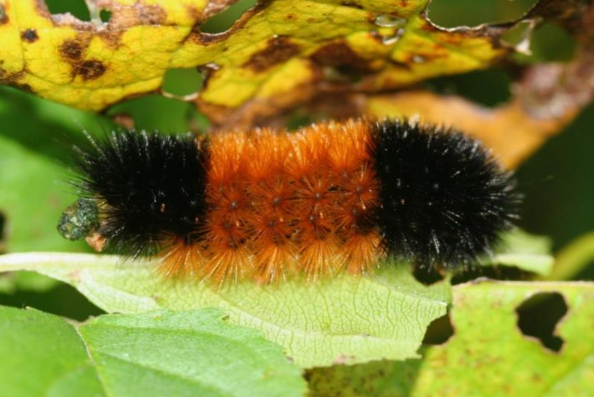
These insects can stand ice formation in the body. Some will actually initiate freezing their body at relatively high temperatures in order to prepare for a longer hibernation. An example of a freeze-tolerant insect is the woolly bear. [Side note: several winter festivals celebrate the woolly bears kinda like Groundhog's Day.]
No matter the overwintering strategy, all insects will eventually die if it gets cold enough. However, the lower lethal temperature is different for each species. Insects can overwinter in any life stage - some are belowground and some aboveground. It gets complicated quickly. And as you can see a lot of insects can withstand very cold temperatures.
Find out more about how insects survive the winter https://en.wikipedia.org/wiki/Insect_winter_ecology
Information provided by Erin Hodgson, Iowa State University Extension Entomologists.
Stacy Campbell is a Crop Production Extension agent in the Cottonwood District (which includes Barton and Ellis counties) for K-State Research and Extension. You can contact him by e-mail at scampbel@ksu.edu or by calling 785-628-9430.