


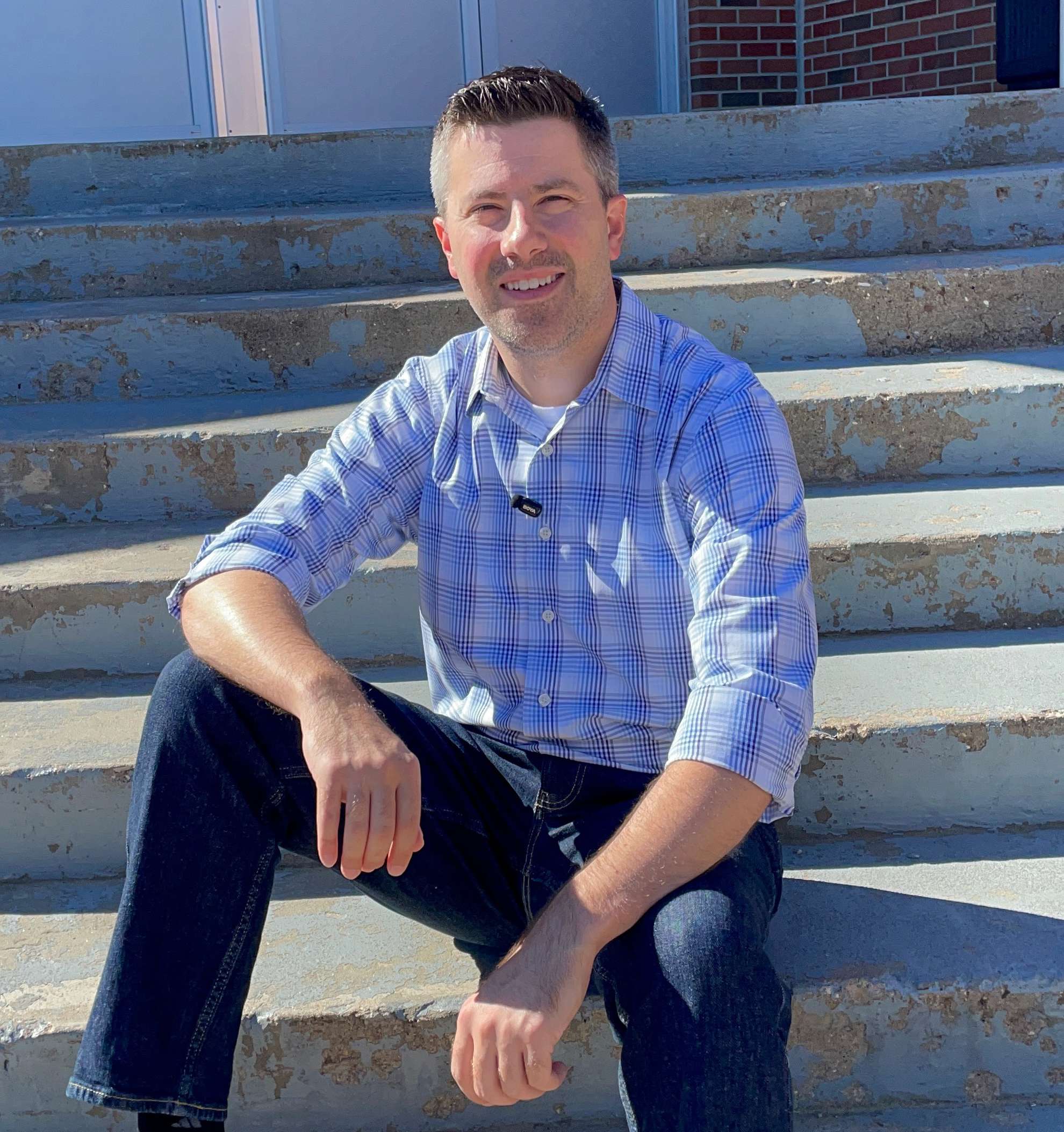
Age: 40
Profession: Grant and technical writer, assistant debate coach, waiter at Handlebar Tavern & Eatery
Community involvement:
Since moving back in 2020, I’ve been highly involved in the community. I founded the Rooks County Democrats. I’ve pushed the city to reengage survey work we’d put off for over 10 years. I’ve worked on the Redbud Development Project as a technical and grant writer, run for hospital board, and started a public speaker series asking legislators and experts on rural development what they would have do to improve the rural life.
This includes hosting Medicaid expansion events and standing up to insurance executive Dan Hawkins, the Republican speaker of the House, who has actively worked to pad his pockets at the expense of our hospitals. I’ve worked with USDA, rural water districts and nonprofits across the state. And, currently, I’m the current assistant debate coach at Hays High.
1. Why are you running for the Kansas House?
To build rural power in the Kansas Legislature. Building rural power means:
1. Being able to hold our elected officials accountable,
2. Building local parties to pass along knowledge of how local and county government works, and
3. Supporting rural public services like schools, hospitals, and first responders.
The rural vote is taken for granted by the legislative leadership in Wichita. Republicans have held a majority in the Legislature since 1993, and a supermajority off and on for the last twenty years.
A supermajority means the Republican Party can override the governor’s veto because they control two-thirds of each chamber.
During this time, Republicans have tried to strip our schools of funding, refused to address rising property taxes, denied hospitals financial loss mitigation tools, refused to properly regulate insurance companies, refused to pass support for affordable rural housing,and undermined our local communities’ ability to provide public services, like a common radio system for local fire departments. All while cutting taxes for the wealthiest people in the state and raising taxes on those who can least afford them.
The women I’ve worked with across multiple county offices, municipalities, court houses, nonprofits and economic development offices finally convinced me to run, believing I would be a superior advocate for our communities in the Legislature. We want to break supermajority with someone who could wield power for our communities. If elected, our district would have leverage for the first time in at least 20 years because both parties would be reliant on my vote to pass anything.
2. What do you think is the top issue facing the Legislature in 2027?
Rural healthcare. Over 70 rural hospitals across the state are at risk of reducing services or closing in the next two years. Hospitals are usually one of the top three employers for rural communities.
Losing a hospital typically starts a domino effect. The local nursing home usually closes within a couple years, which is also a top three employer. After losing both the nursing home and hospital, EMS, fire and police services see cuts. Schools downsize rapidly, forcing district consolidation. Employees find work elsewhere, creating a housing sell-off, forcing higher property taxes.
When the only growing population in the district is those over 55, who are more likely to have fixed incomes, increases in property taxes hit hard. And with federal cuts to Medicare and Medicaid attacking approximately a third of budgets for critical access hospitals in the district, we are looking at an existential threat to at least two counties in the district.
3. What would be your top priority in Topeka if elected?
Rural health care development. In the next session, there are three items I intend to vote for as soon as possible.
First, Medicaid expansion. This has multiple benefits, such as ER loss mitigation for hospitals, allowing about 150,000 Kansans (over 40,000 of which are children) affordable health care access, and decreasing the rate at which insurance premiums increase per year.
Second, insurance regulation. Rural hospitals are compensated less for the exact same procedures urban/suburban hospitals perform. The insurance commissioner should be empowered to penalize insurance companies for rural pricing discrimination.
Third, Medicaid housing lien reform. Almost a third of our unoccupied housing in the district is due to a Medicaid lien. It takes years to resolve the lien, especially if the owner of the house passes away. I’m proposing to have that housing immediately deposited into a municipal land bank.
Local health care institutions, like a hospital or nursing home, could purchase the housing at a discount and offer the housing as a hiring incentive.
4. Higher education institutions across the country are seeing enrollment declines. How would you support higher education, including capital needs, while keeping tuition affordable? Would you support state funds to save the Sternberg Museum?
First, I would support an immediate infusion of funds to save the museum. The state never should have made that cut in the first place, and my opponent never should have voted for the budget that contained that cut, which I believe was HB 2513.
Funding education is the primary responsibility of a state legislator, per the state constitution. The boys club in Topeka wants to limit your freedom to discover knowledge and have a degree of mastery over your economic future. That’s why they’re decreasing funding to all schools across the state, with the eventual goal of total privatization of the education system. This will be a disaster, as privatization experiments in Arizona and Iowa have shown, with rural schools getting hit first and hardest.
The larger enrollment problem hinges on federal cuts to student aid that I cannot address as your state representative. However, I will do whatever I can to mitigate the impact of those cuts.
I also think we need to change the narrative that college is critical for a career. Speaking as former college teacher, college is not job preparation. It helps, but that can no longer be the selling point with the emergence of AI and corporatization of our workforce. We need to revive civic education as a key selling point for college.
5. How do you think the Legislature should address property taxes? Do you support the cap that failed to become law last session? If you support a different plan, what is it?
We need to think outside the box on property taxes. The current debate only offers two solutions: capping evaluations or capping mill increases. Neither are viable. The No. 1 cost municipalities, counties and schools are facing is insurance increases, whether that’s for first responder equipment, buildings and/or health care for employees.
If we capped property evaluations, the city or county would just have to raise more mills to pay the bills. If we capped mill levies, evaluations would continue to rise, and we’d risk a school district, city and/or county being unable to pay their bills. These solutions would cause the state to look an awful lot like California, with its incredibly high property taxes.
My previous opponent, Cody Ward, supported reinstating the Local Ad Valorum Tax Relief Program (LAVTR) that Republicans stopped funding in 2003. My current opponent, Ken Rahjes, voted to eliminate this program in 2025, as did the entire Republican supermajority.
The Local Ad Valorum Tax Relief Program allowed cities and counties to apply for state general funds instead of increasing mill levies to offset new expenses. In exchange, cities and counties would do routine things, like complete surveys and provide local data to the state. I would support this program, but it is a band-aid to a deeper problem.
There are two things we need to do to address the root cause of rising property taxes. First, we need to rethink the formula for evaluations, which has not been done in almost 50 years.
Second, we need a new revenue stream to cities, counties and schools. I’m proposing a rural sovereign wealth fund. The basic idea is to create a new revenue stream for schools, cities and counties. The state would take, say, $1 billion, and invest that into the market. Taxing districts would then be allowed to invest a portion of their budget each year into the fund, which would produce a return. Over time, the return could potentially decrease or eliminate the need for property taxes, depending on the investment over time.
This is not a quick solution. It would need a minimum of 10 years to begin producing results with a stable economy. Representative Blake Carpenter, a Republican, has already proposed something similar to replace income taxes. So, there is a lot of room to develop this idea and people across the aisle I can work with to further refine it.
6. Do you think the K-12 funding formula needs to be changed? How? Would you support more state funding for special education?
We should fully fund special education, and I will vote to do so. No excuses. My opponent has come up with many excuses to not fully fund special ed.
I do believe the K-12 funding formula needs to be changed. Rural schools deserve the same level of funding as urban and suburban schools. That means making sure debate teams do not have to fundraise to travel to tournaments, football teams have equipment to keep the players safe and teachers are not buying classroom supplies if you are rural.
It also means paying teachers enough to afford rent and still have a little left over for savings. Because underfunded rural schools cannot pay competitive salaries, teachers are our second largest labor export to other states, right next to nurses.
7. Do you think the state needs to ban or further regulate data centers?
I would support a ban on future data centers. Data centers are staples of mass surveillance, which absolutely no citizen has given consent to. Whether it’s Flock cameras, training AI models or Amazon purchase histories, the data being stored in these is being used against the common good.
Purchase histories are used to target rage bait, AI models are designed to replace intellectual labor and camera data is being used to link innocent people to crimes they never committed.
Furthermore, our district does not have the water necessary for a large-scale data center project. Air-cooled data centers generate tremendous noise pollution. The jobs promised never materialize. We forfeit good farmland and agricultural opportunities for false promises and environmental degradation.
8. What if anything, do you think the state should do to promote cyber security? Do you think the state needs to regulate AI? If so, how?
I’m not an expert in cybersecurity. As I understand it, right now cybercrimes are mostly handled by the Attorney General’s office. I’m forward to working with Chris Mann when he is elected state attorney general to address any cybersecurity issues.
As a former college speech and composition teacher, and currently as a debate coach, AI is terrifying. As a research tool, it makes discovering information much easier. I think the intent was for AI to work like the computer in Star Trek—query and receive accurate information.
But when the information generated is not correct—or worse, designed to be rage bait—and AI repeats that information without questioning its validity, it ceases being a useful information-gathering tool. Or when AI writes a paper for a student, the student is robbed of valuable opportunities to create critical thinking skills and solid writing habits.
In short, it encourages us to no longer master basic educational and creative skills, and instead, intensifies a preexisting toxic rage-bait internet culture.
So, I believe we should ban AI use for everyone younger than 18. Students, especially minors, should have a certain level of research, language and writing skill before being allowed to use AI.