


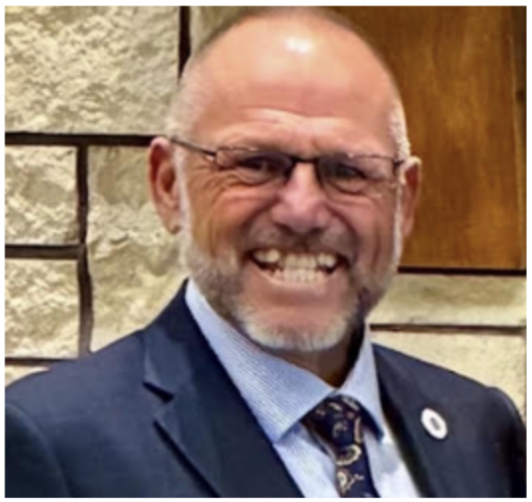
Party: Democrat
Age: 58
Profession: Retired captain with Kansas Highway Patrol and current WaKeeney chief of police
1. What specific aspects of the magistrate judge position motivated you to run?
I have enjoyed my career as a state trooper and police chief; however I knew that this season as a law enforcement officer would not last forever. I have enjoyed a very satisfying and successful career, but knew some day, before I reached “normal” retirement age, I would need to seek employment in a position suitable to my abilities if I wanted to continue to serve.
I have always been intrigued by judicial proceedings and have been successful in the many trials that I have testified in during my 35-year career.
I understand the importance of impartiality and practiced it in my career as a Kansas state trooper, retiring as the Troop D Captain, and continue to practice it as the chief of police of WaKeeney.
I have sought this path of magistrate judge for well over many years and ran as the Republican nominee in the 2024 elections. I am confident in my direction, and I want to be our communities next elected magistrate judge in the 23rd judicial district where I know I can make a difference.
2. What experience and skills would you bring to the position?
I have spent over 35 years in law enforcement, 31 years being with the Kansas Highway Patrol. I bring with it a degree in criminal justice and a perspective of experience, having personally dealt with many of the crimes I will likely proceed over and adjudicate.
I have also given testimony in countless courtrooms across the United States. I have testified in state and federal hearings ranging from traffic infractions to murder trials.
I have spent a great deal of my career developing my own leadership abilities and have brought others into leadership roles. I have lived in our community for nearly three decades and have an tremendous desire to serve the people who know me and know I care.
I look forward to the possibility of bringing this background into the courts of the 23rd Judicial District to deliver experienced, fair and impartial verdicts.
3. What qualities do you believe are most important in an effective judge?
The most important quality of an effective judge would be their ability to instill confidence in the judicial system to deliver justice in the communities they serve.
To accomplish this, they will need to have the inherent ability to be an impartial listener of the facts. An effective judge should ensure that proceedings before them are adjudicated with decorum and fairness.
As an effective judge, I will seek justice and justice alone, ensuring that both the victims of crime and the perpetrators of crime are treated fairly and receive the justice they deserve. As an effective judge, I will be present in our community, assuring our community that I am there to serve them.
4. What is the most challenging ethical dilemma you have faced, and how did you handle it?
I would say the biggest ethical dilemma I have faced in my career involves the use of deadly force to stop an imminent lethal threat.
One such occasion involved a wanted felon faced with returning to prison. This person chose to drive head on with traffic traveling in the opposite direction on an interstate system.
As vehicles swerved to avoid certain fatal collisions, I processed the inherent dangers the innocent travelers were faced with and decided to stop the threat by utilizing my patrol vehicle as a weapon.
I collided with the wrong way driver at 90 miles per hour moments before he had another opportunity to crash into a white sedan in the driving lane.
As I forced his vehicle into a bridge rail, it also caused my patrol vehicle to crash into the bridge rail. I knew the act of force may end the felon’s life, but I could not watch him purposefully crash into an innocent bystander.
All involved were fortunate that night and only vehicles were destroyed in the collision. The suspect was taken into custody.
In law enforcement, ethical dilemmas can occur in a heartbeat, and one must then live with the decision that was made in the moment.
5. What community activities or organizations have you been involved with?
Nearly 30 years of law enforcement experience has been spent in Trego County. Having grown up near Trego County, my wife and I chose WaKeeney to live, raise our children, and we plan to eventually retire here.
During my time in Trego County, I have or am currently serving in the following capacities:
-USD 208 school board member
-FFA Alumni board secretary and member
-4-H member and volunteer
-Vice president of the CASA of the High Plains
-Trego Community bus committee member
-Lions club member
-Trego Eagles Booster Club member
–10-33 Foundation volunteer (a peer support group for first responders)
-Keynote speaker at Fields of Faith for the Fellowship of Christian Athletes
-International Youth Convention chaperone for area youth to Cincinnati, Ohio
-Northwest Kansas Men’s encounter launch point leader
-5th-Quarter youth gathering chaperone
-Monthly Cops and Coffee events for the long-term care unit residence at Trego Lemke Memorial Hospital
In addition, my wife of 33 years and I attend the WaKeeney Church of God and actively support our schools, churches, area youth fundraiser and area non-profits. I have worked extensively with northwest Kansas law enforcement, improving the safety of our schools, churches, children, communities and roadways.
6. Have you ever been arrested? If so, when, on what charges and what was the outcome?
Nearly 39 years ago now, while attending Oktoberfest as a teenager, I engaged in youthful indiscretion as I possessed an alcoholic beverage while under the age of 21. I was 19 years old at the time.
I purchased the beer in a decorative Oktoberfest mug for a souvenir. My role that day was that of a designated driver.
You see life has a way of shaping you or defining you. I had convicted myself to a life of sobriety having witnessed my mother find sobriety when I was 9 years old. I chose to let those nine years shape me and not define me.
My interaction with a very professional Alcohol Beverage Control agent that day was a good lesson in life, teaching me as a teenager that trying to fit in has its consequences.
Though I had not taken a drink from the mug, I was entirely guilty of the crime of underage possession of an alcoholic beverage and though I was not physically arrested, I was cited for the violation and given a court date.
The Honorable Judge Scott took my guilty plea. I would later have to explain my actions as I made my way through a background investigation to join the Kansas Highway Patrol.
7. Have you ever been a victim of a crime? If so, how did the experience affect you, if at all?
Throughout my career in law enforcement, I have had many occasions to be named as a victim involving crimes such as battery on a law enforcement officer, assault on a law enforcement officer and criminal damage to property.
I have also been named as a victim of attempted murder on a law enforcement officer.
To understand how it affected me it is necessary to frame the events of the day. I had responded to assist another agency that had come under fire from a person with a high-powered rifle.
When I arrived, I knew it was necessary to contain the suspect and not allow him the ability to leave containment. I positioned my patrol vehicle to not allow an avenue for his escape.
I took cover behind the engine block of my patrol car as the suspect shot rifle rounds through my passenger side door. There was no doubt about his intent.
After a lengthy standoff, the suspect was taken into custody, and nobody lost their life that day. In the moment, the experience had very little effect on me or the other officer who came under fire that day.
We had a duty to not allow the threat to leave the containment and threaten innocent people. We did our jobs and were fortunate that no one lost their lives.
The effect of these events came when my patrol car with bullet holes in the door was parked in my driveway. You see the families of law enforcement suffer collateral damage to our jobs.
The experience of watching my wife and daughters try to process someone trying to kill me was much more difficult than coming under fire myself.
8. How would you balance moving cases through the court efficiently with ensuring each person has a fair opportunity to be heard?
I retired from the Kansas Highway Patrol as a troop captain. This position was very demanding as it covered the 18 northwest counties in Kansas.
It included over 16,000 miles of state and federal highways. I was responsible for the many state troopers, KDOT workers, other law enforcement agencies and citizens who work and live here.
During my career, I’ve handled countless major events and critical incidents. I am certain our community has confidence in me and know that I have no problem making hard decisions, finishing what I have started and achieving positive outcomes.
Managing caseloads with efficiency all while protecting our citizens’ right to due process and access to justice has a high-priority outcome and ensures those brought into the judicial system will be treated fairly and justly.
I have been involved in criminal justice system for over 35 years and understand the rights of the accused. I have testified in city, county, state and federal courts more times than I can recall.
To accomplish these priorities, I will work the hours needed to ensure all are heard and cared for, just as I have done in my law enforcement career. I will make certain all are treated fairly, timely and justly to the best of my abilities.
9. Magistrate judges handle a range of cases. How would you prepare to make fair, well-informed decisions in areas where you have less direct experience?
At this point in my criminal justice career, I have been exposed to a multitude of scenarios, crimes and situations.
I understand there will be a learning curve as I adjust from a position of “bringing one to justice” to “delivering justice."
What I do bring with me is the ability to listen, learn and apply common sense and perspective. I am fully prepared to accept guidance from those who value my success as a magistrate judge.
I have held leadership positions in my career, and each required me to learn a new set of skills to ensure those I lead were treated fairly and had the tools they needed to do their job and go home at the end of their shifts.
Transitioning my skill set to the magistrate judge bench will require study, but it will not be unfamiliar to me.