


By TONY GUERRERO
Hays Post
As property taxes continue to frustrate Kansans, a tax policy expert says many of the relief options being discussed in Topeka have significant drawbacks.
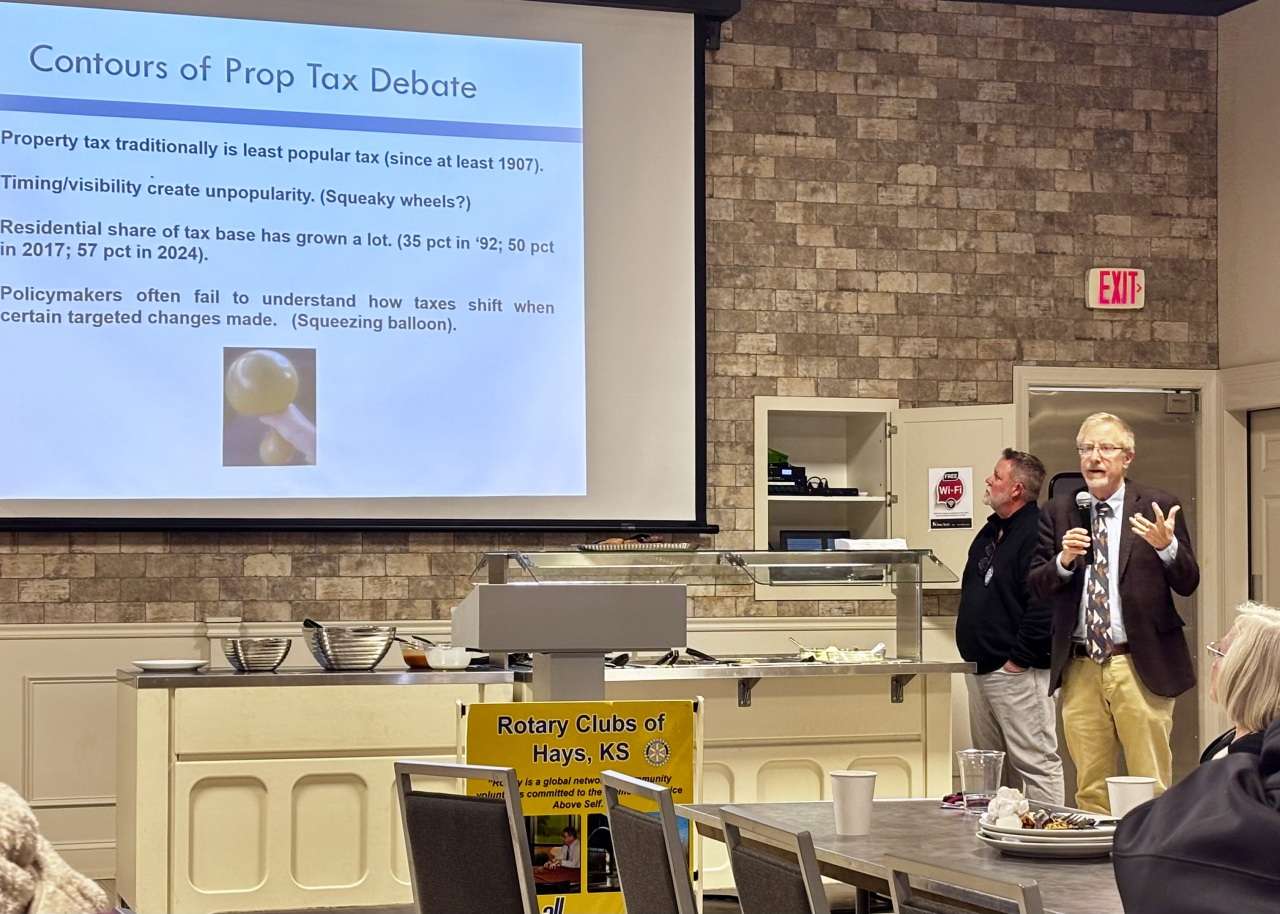
Chris Courtwright, a member of Gov. Laura Kelly's Council on Tax Reform, spoke to Rotary attendees on Monday at the Venue in Hays. He is the author of "Kansas Tax Facts," a guide on Kansas state and local tax policy.
"There aren't any great solutions, regardless of what the politicians suggest," Courtwright said.
Courtwright retired after 34 years as the Kansas Legislature’s principal economist and a member of the Consensus Revenue Estimating Group. He is an author with the Kansas Reflector.
He began his presentation by citing the Kansas Constitution, which requires the Legislature to provide adequate and equitable funding for public schools.
Courtwright said about 40% of all property tax revenue goes to schools. While he supports funding education, he said the overall property tax burden still needs to be addressed.
He also provided background on the history of property taxes and why they have long been unpopular with taxpayers.
"The last time we amended the Kansas constitution in a meaningful way when it came to property taxes was the early 1990s. The taxes on our residential houses were about a third of all property taxes. It's now two-thirds of the property tax base," he said.
Courtwright said that reducing property taxes for one group often shifts the burden onto others. He compared it to squeezing a balloon; when one side shrinks, another side expands.
There are more than 4,000 property tax subdivisions in Kansas. Courtwright said state and local taxes combined are $21 billion, with local governments contributing about 42% and property taxes about 34%. Property taxes are about 80% of local taxes.
"Property taxes have always been the workhorse of local finances," Courtwright said. "Locals get all their money from property taxes. ... They're the bread and butter."
According to Courtwright, the median residential sales price in Ellis County is $230,000 for a house. As of January, the mean residential value is about $160,000.
Courtwright said the two kinds of relief are under discussion right now.
Option one is to reduce the statewide school property tax that helps fund public schools. Lowering that rate would decrease property taxes for all property owners, but the state would have to replace every dollar lost with money from the state general fund.
Option two would reduce property taxes specifically for homeowners by increasing the amount of a home’s value that is exempt from the statewide school property tax. Businesses, agriculture and other properties would not be included.
In 2024, lawmakers gave property tax relief exclusively to homeowners by keeping the mill levy at 20 mills while increasing the residential exemption from about $44,000 to $75,000.
Courtwright said the change only provided about a $71 tax cut for every home in the state valued at least $75,000.
He also cautioned against valuation caps, saying those policies can create inequities and may lead to higher taxes elsewhere over time.
"There are generational equity issues. It makes it harder for young people to buy homes. We become the land of aristocracy," he said.
"Doing this makes it that much harder for younger people to stay in the state and find housing. There are a bunch of reasons not to do this. The right-of-center Tax Foundation says don't do this," he said.
Courtwright said lawmakers are discussing putting a valuation cap on the ballot in 2026.
He emphasized property tax cuts involve trade-offs and money used to reduce property taxes could instead go toward priorities such as education, Medicaid expansion or social services.
Courtwright's recommendation to cut property taxes would be to lower the residential assessment rate in the Kansas Constitution from 11.5% to 9%. However, he noted passing such a change would be difficult because other property groups would likely oppose it.
"If you put that on the ballot, homeowners would vote for it, but then the balloon would get squeezed in a different direction. Some of the other classes of property... those lobbies aren't gonna let that get on the ballot," he said in response to a question about possible legislation that can balance residential property taxes.
Other ideas, he said, lawmakers could consider are
• Expanding “circuit breaker” or programs that give property tax refunds to seniors, disabled residents and low-income homeowners.
• Give local governments more types of taxes, such as liquor, cigarette or fuel taxes, so they rely less on property taxes.
When asked about proposals by some lawmakers to eliminate property taxes, Courtwright called the idea “a cruel hoax.”
"There is no way in so many areas of the state that it would work," he said. "It's absurd. They're just doing it because it's an election year and because they can't afford to do any of the stuff I've been talking about."
Courtwright also suggested if the state has extra money available for tax cuts, lawmakers should consider other types of tax relief rather than focusing solely on property taxes.