


By TONY GUERRERO
Hays Post
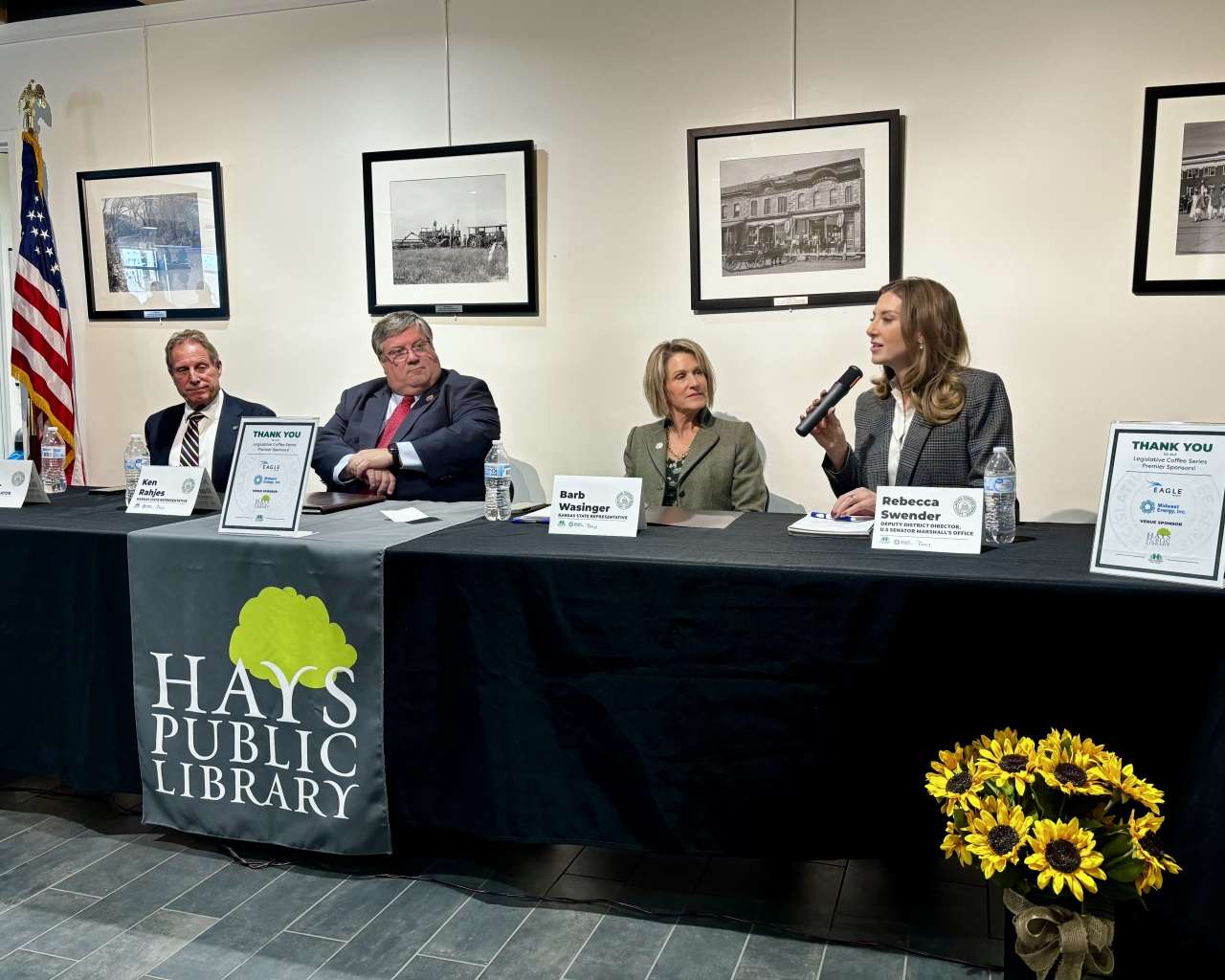
Local Republican legislators discussed several rural issues, such as transportation and health, at Saturday's legislative coffee in Hays.
Kansas Sen. Rick Billinger, R-Goodland; Rep. Ken Rahjes, R-Agra; and Rep. Barb Wasinger, R-Hays, spoke to attendees at the Hays Public Library
Rebecca Swender, district director for U.S. Sen. Roger Marshall, R-Great Bend, also attended and answered questions during the closing portion of the discussion.
Rural senior transportation
The panel acknowledged that transportation for seniors in rural Kansas is a growing issue as the population ages.
"We've talked a lot about the Meals on Wheels program and a bigger package of assistance to give to our area agencies," Rahjes said. "It's a process. We're not there yet."
Wasinger said the issue is expected to come up in the Legislature next week and noted her support for ACCESS transportation, which is facing a funding shortfall heading into 2026.
Rural Health Transformation Program
The Rural Health Transformation Program is set to provide about $222 million in 2026 to help expand primary care, support the health care workforce and improve health data.
Wasinger said her concern is where the money ultimately goes.
"If it just goes to the governor to make decisions, we're afraid it'll go to KU Med Center and Via Christi," she said. "We've asked for transparency and accounting to make sure we get some of that money out in western Kansas, especially to HaysMed."
Rahjes said talks are ongoing with Blue Cross and Blue Shield over reimbursement practices for HaysMed. Swender said Marshall backs the program and wants guardrails in place to ensure the funding reaches rural hospitals.
Conservation funding
A recently introduced House bill would require county commissions to approve conservation easements, increasing government involvement and limiting private property rights.
Rahjes said lawmakers, in broader terms, are "getting out of their lanes" with proposed bills. He emphasized that decisions are best left to local officials who are closest to the people.
"Me living in Agra should not tell Wichita County what they should do with their kids. Johnson County shouldn't tell Hays how much water they should use, and Hays shouldn't tell Johnson County how green their yard should be," he said.
Rahjes said it is unlikely to advance.
Dedicated state conservation fund
Kansas is one of about 15 states without a dedicated conservation fund. The panel was asked whether they would support creating one to help producers, provided it did not involve new taxes.
"The biggest problem that I see as a rural legislator is trying to educate Johnson County and Wichita to understand that our lives are completely different," Wasinger said.
Rahjes said a $17 million conservation package was recently approved, and $1.7 million in funding for local conservation districts was restored.
"If we don't have good conservation, which goes into water, then we're just dust. We can argue about everything in the world, but without water, we don't survive," Rahjes said.
Artificial intelligence
Billinger said Kansas can expect many AI data centers, raising several concerns.
"The biggest issue right now is they use a lot of water, way more than electricity," he said. "We were at a conference a couple of months ago, and it was said we need to double the amount of electricity we have today in the next five years."
Rahjes said lawmakers are aware of concerns around AI generating fake images, voices and advertisements, specifically how it could be used in campaigns to mislead voters.
"I don't see AI voting. You still have to vote in person," Rahjes said. "With AI, we're just in the beginning of all this. Think back when social media started. Who would have thought we are where we are today?"
Wasinger noted the legislature passed a bill last year creating penalties for certain AI abuses, such as altering images of children.
College athletics revenue-sharing
Recently, the University of Kansas, Wichita State University and Kansas state representatives have asked legislators to allocate more tax dollars to help cover an estimated $20.5 million in direct athlete revenue-sharing payments tied to name, image and likeness (NIL).
Billinger and Wasinger said they would not support this.
"My suggestion is to look at how much they have in unencumbered funds and in their foundation funds. There are billions of dollars in there. Use that money," Wasinger said.
Rahjes said he also does not support the proposal but is developing a voluntary alternative that would allow taxpayers to contribute to NIL efforts through their state income tax returns.
Rebecca Swender
45Z tax credit and benefiting local farmers
Swender said although many clean energy tax credits were eliminated in last year’s federal tax legislation, the 45Z tax credit remained in place.
Swender said the 45Z credit is a biofuels tax incentive that directly benefits Kansas farmers, and ethanol and biodiesel plants. She credited Marshall’s advocacy with preserving it.
"It makes sure that all the ethanol is produced from 100% American grown feedstocks. We can't import used cooking oil from China and make that into ethanol. It has to be American-sourced fuel," Swender said.
340B funding for HaysMed
When asked about progress on 340B funding for HaysMed, Swender said the hospital does not qualify under the program because it is not considered a critical-access hospital.
340B is a medication discount program.
"There's a lot of hope that 340B can be revisited. There are a lot of bad actors within the program, and there are a lot of dollars going where they're not intended to go," Swender said. "Until we can [fix that], I don't know if they will open it up to new employers."
Tariff relief
Swender said tariffs are “tricky,” and Marshall continues to support President Donald Trump’s tariff policy as a long-term strategy.
She said while relief through appropriations may be easier, the purpose is to create leverage to renegotiate better trade deals.
Credit Card Compensation Act
Swender said Marshal supports the act as it is a major policy fight in Washington between big banks and Main Street businesses.
The bill aims to reduce credit card "swipe" fees by requiring credit cards from banks with more than $100 billion in assets offer at least two network options—one of which cannot be Visa or Mastercard.
She said the bill aims to reduce high credit card processing fees and lower costs for consumers and small businesses.
ICE in communities
Swender was asked about what steps are being taken to protect communities from ICE. She said that ICE is here to protect Americans and that Marshall intends to have ICE work alongside local law enforcement.
The final two Legislative Coffees are set for 8:30 a.m. on Feb. 28 and March 28 at the Hays Public Library, 1205 Main St.