


By CRISTINA JANNEY
Hays Post
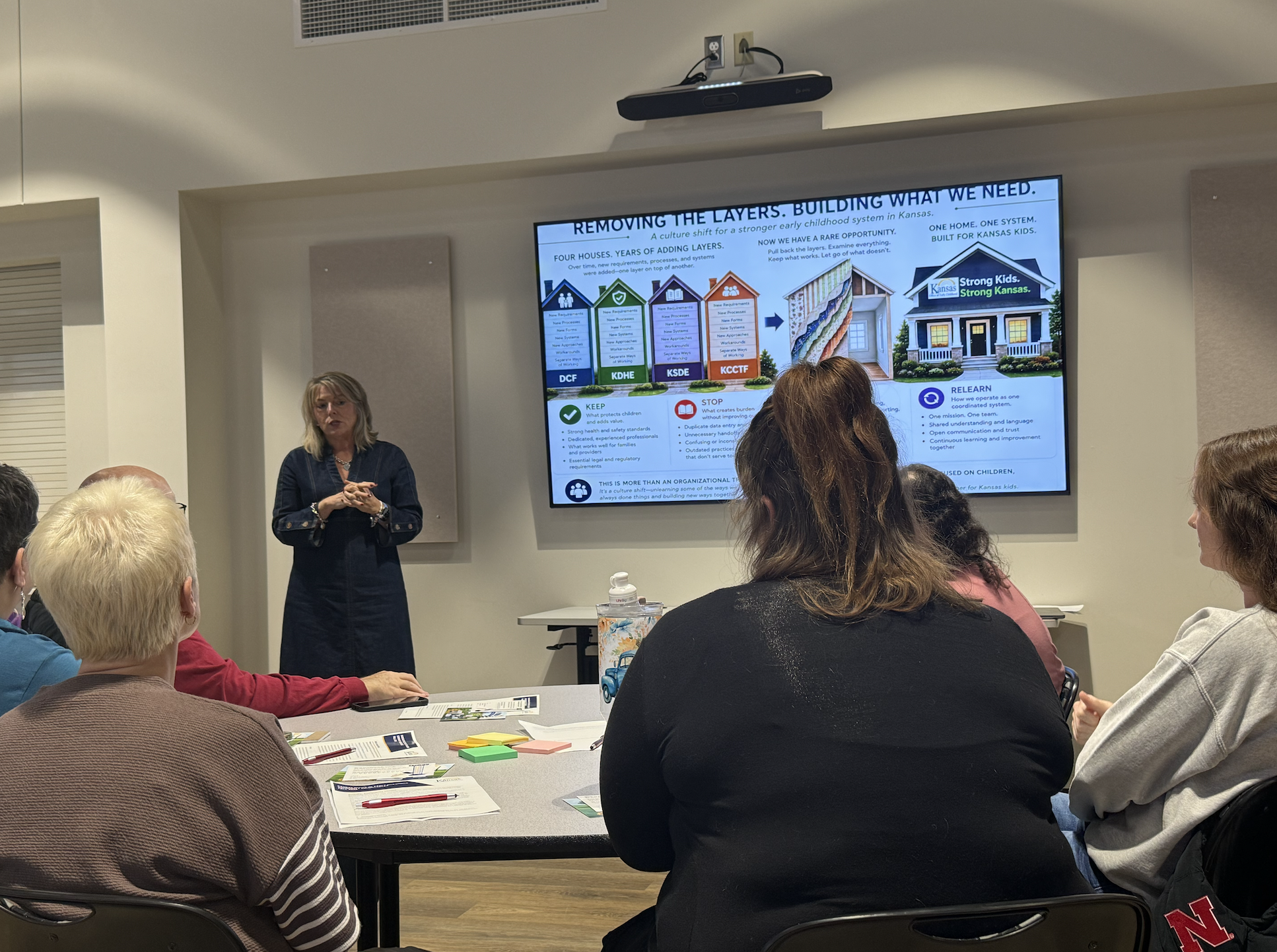
The director and staff members were in Hays on Oct. 29 to talk to providers about the newly established Kansas Office of Early Childhood.
Providers also discussed challenges they face.
Christi Smith, director of the Kansas Office of Early Childhood, said the office is trying to determine the best way to create efficiencies for providers and parents as it consolidates functions from four state agencies.
The new agency has merged early childhood functions from the Department of Children and Families, the Kansas Department of Education, the Kansas Department of Health and Environment, and the Kansas Children’s Cabinet and Trust Fund.
Preschool programs will remain under the Department of Education, and child care subsidies will remain under DCF.
Smith said keeping the child care subsidy application under DCF gives families a one-stop shop for assistance, so they don’t have to fill out applications with multiple agencies.
The providers discussed barriers they see to keeping their doors open and communicating with parents.
Dana Stanton, child care specialist for the Northwest Kansas Innovation Center, said many communities she works with say they need drop-in care.
However, she said when asked how to achieve that, most providers and community members are at a loss as to how the service could be financially sustained.
“And then everything gets quiet, and then they'll say, ‘Well, we'll have our current providers provide drop-in care.’ I'm like, ‘Yeah, well, if they hold those slots open, that means they don't get paid.’ They're like, ‘Oh.’
“So, it's a huge need. The providers need it so they can take a day off. The parents need it so they can have a backup. But there's no way to fund it,” Stanton said.
Funding to assist families pay for care is available through DCF; however, one provider said the paperwork can be burdensome. It also does not cover the full cost of care, leaving the onus on the provider to collect the remaining cost.
One provider said she lost money because she couldn’t collect, so she stopped accepting children who received a DCF subsidy.
“It's not that I don't want to help the families, but again, I work because I have to,” she said.
Stanton said financial help is available for nonprofit child care facilities, but in western Kansas, 92% of child care is done by for-profit in-home providers.
Providers also expressed concerns about the necessity to educate parents. Providers said parents often don’t understand the importance of play in building fine and gross motor skills.
They expressed concerns about children spending too much time on screens.
They said children are also lacking coping strategies and social skills.
Providers said they try to engage parents, share information from credible sources and encourage them to participate in parenting classes or Parents as Teachers, but many do not.
“I'm trying, especially the younger families because they don't know, but they don't know what they don't know,” one provider said.
Jean Hertel, Early Childhood Connections 0-3 social services coordinator, said her agency struggles to get parents to sign up for programs. Their program used to have 15 parent educators and now has 1.5.
She said it is not an issue of not having enough staff; it’s an issue of lack of participants in the programs.
Many programs used to receive referrals through a maternal-child health visitor who visited mothers in the hospital when their children were born.
That program no longer exists. HIPAA regulations also have created limits on maternal visits in the hospital.
The group discussed background checks. They said, in many areas, having fingerprints done for background checks can be burdensome for providers and the law enforcement officials who usually handle fingerprinting.
They suggested the regulations be changed so providers and their employees only have to do the fingerprinting once, and those prints be kept on file for future background check renewals.