


By TONY GUERRERO
Hays Post
The Ellis County Sheriff voiced support for legislation providing protection to counties that hold detainees for ICE after signing an agreement with the federal agency.
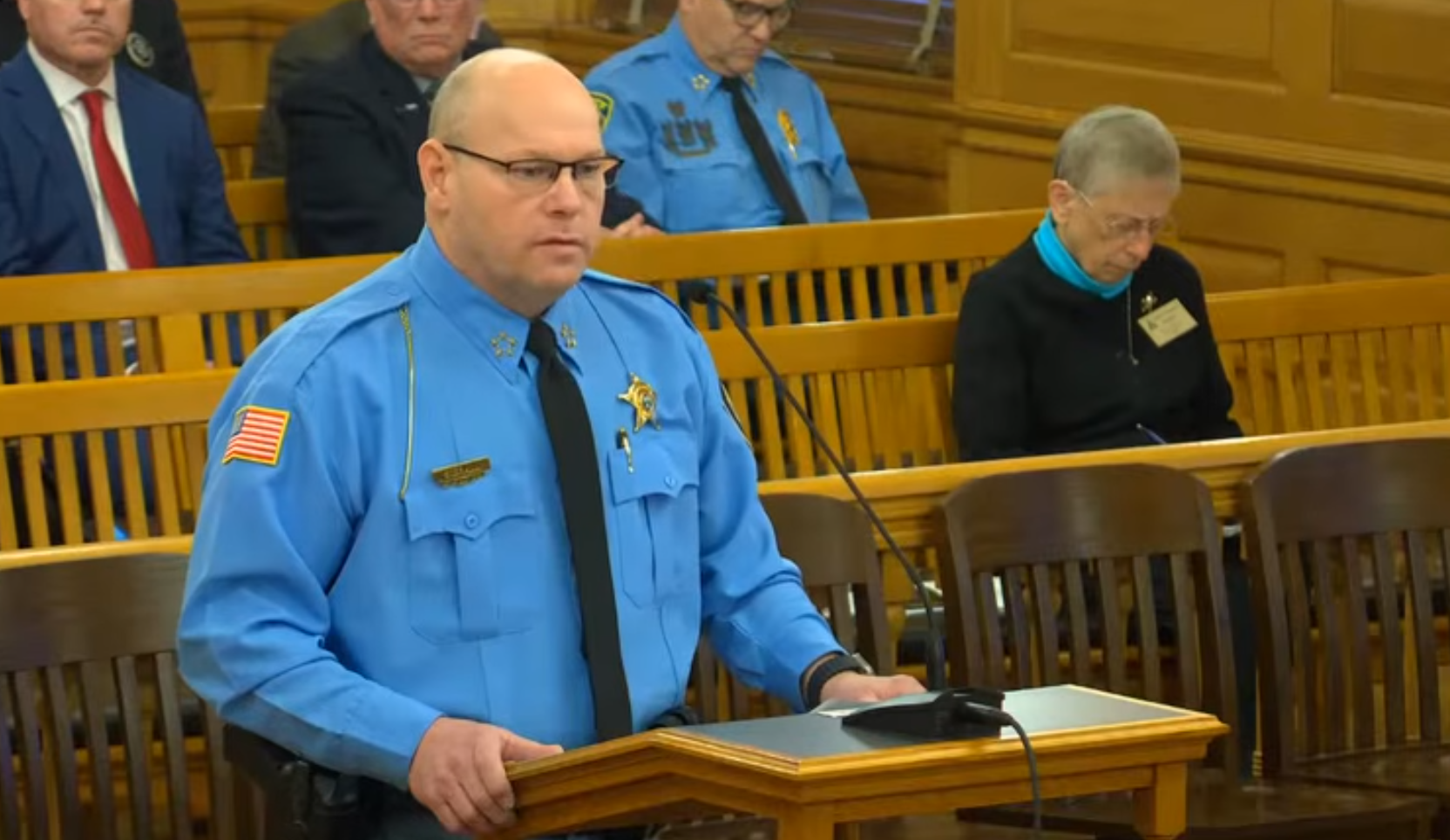
Ellis County Sheriff Scott Braun told a House committee on Feb. 25 in Topeka that he signed a memorandum with ICE to prevent the county from potentially losing millions of dollars in funding.
House Bill 2771 addresses how county sheriffs operating jails may enforce immigration detainers. The bill would require municipal insurance pools to provide liability coverage for law enforcement agencies enforcing federal law, requiring the state to pay certain judgments in potential federal civil cases and provide legal representation through the attorney general.
The bill would allow sheriffs who operate jails to hold individuals for up to 48 hours based on an ICE detainer or certain federal warrants to transfer them to federal authorities.
The bill would also establish procedures for reviewing detainers, notifying detainees and releasing individuals under certain conditions, including when proof of U.S. citizenship or lawful immigration status is provided.
The bill’s protections apply to law enforcement agencies participating in ICE’s 287(g) program, which allows ICE to authorize state and local agencies to carry out certain immigration enforcement duties under federal supervision.
Braun told the House Committee on Federal and State Affairs that his department has entered into the agreement, which has since raised questions about what counties are allowed to do.
"If you recall, there was supposed to be cooperation with local law enforcement and inviting them to be more involved with immigration," Braun said.
Braun said that after learning about issues with the Kansas County Association Multiline Pool’s coverage for holding ICE detainees, he met with the Ellis County Commission to discuss federal grant funding and whether signing the agreement could affect those funds.
Braun said in May 2025, the county association’s liability pool notified him that the ICE memorandum agreement places responsibility and costs on local agencies because coverage does not apply to activities carried out in a federal law enforcement context.
"Basically, we're dealing with detainees trying to keep our community safe, but we have no assurance through the KCamp side," he said.
Braun said his department could have faced liability if it had signed the agreement with ICE. However, he added that not signing the agreement would create challenges for Ellis County.
"We have a decent population, but we struggle with budgets, funding, etc. ... Our commissioners believe that it was in our best interest to sign [the ICE agreement] to ensure we get our dollars when we apply for grants," Braun said.
Braun explained to committee members that the grants support road projects and law enforcement, and that he signed the ICE memorandum at the direction of the county commission despite knowing there were “holes” in it.
"We would have lost somewhere between $2 million and $3 million, of which $327,000 comes to the sheriff's office for equipment," Braun said.
Braun said liability exposure extends beyond immigration detainers and also affects sheriffs whose employees serve on federal task forces such as the FBI, DEA, ATF and U.S. Marshals Service.
"This issue is not about politics. It's about clarity of liability, fiscal responsibility and protecting Kansas sheriffs, counties and taxpayers from a catastrophic financial exposure," Braun said.
Braun was asked why he supports the bill, which would allow sheriffs to sign agreements without county commission approval, despite having a good relationship with his commission. His response was due to uncertainty about future leadership.
"We never know who the next sheriff is going to be, and we don't know who the next commissioners are. They may not have that relationship," he said. "We would like that authority to sign the contracts."
Braun was also asked whether his department had considered ending its agreement with ICE because of the issues surrounding it. He said the department has not had that discussion.
"We've got to look at how to protect our community. That's our main reason for still being in that program. Dollars come into play, but that's not our most important reason. We want to make a safe community, and those who violate the law and commit heinous crimes probably shouldn't be with us within our country," he said.
Sedgwick County Sheriff Jeff Easter also spoke in support of the bill and answered questions from the committee.
Easter provided additional details on the different ICE program models outlined in the memorandum and how ICE uses FBI databases, which jails are required by law to report to, to identify individuals who may be in the country illegally.
Opponents testify against the bill
Several opponents told the committee the bill should not remove county oversight, could disrupt relationships between immigrant communities and local law enforcement, should require a judge-signed warrant and might negatively affect local economies.
Rabbi Moti Rieber, executive director of the Kansas Interfaith Action, said he understands why sheriffs support the bill but remains opposed to it.
"The two specific concerns we have are the 48-hour retainer. We think under these circumstances it should be a judicial warrant rather than an administrative one. Also, this ability for the sheriffs to unilaterally sign 287(g) agreements, that should remain in civilian hands and county commission hands," he said.
Logan DeMond, director of policy and research at ACLU of Kansas, said the bill cannot be viewed in isolation and called it another attack on immigrants in the state.
"I would be remiss if I also failed to mention the legal implications of this bill and the risk of exposing the state of Kansas to federal civil rights litigiation thanks to the obvious violations of the Fourth and 14th amendments," DeMond said.
Alejandro Rangel-Lopez, campaign manager for New Frontiers, said the bill would allow federal overreach in the state and could weaken trust between immigrant communities and law enforcement.
"I urge you to reject the bill and preserve the trust that we have between our local law enforcement, including our sheriffs, that they built up over decades," Lopez said.
Erica Andrade, president of El Centro, said the bill would not make communities safer and could make families afraid to report crimes. She also said county commissioners are elected to represent their communities and opposed agreements that bypass their approval.
Johnny Dunlap of Spearville said the bill would be an economic disaster.
"We have a meat packing plant in southwest Kansas that allows people to earn a fairly good wage without the necessity for training or education ahead of time, so it's drawn to the immigrant population," he said. "If those folks leave, our economy is going to be at risk."