


By KAREN MADORIN
Those who play connect the dots find the experience relaxing or agitating, depending on results. Some recognize relationships between one concept and another but possess too little information to verify them. Complicating matters, lack of time or money limits investigation. I understand this tension, especially after reading articles about Clovis caches found in North America.
Few share my fascination with Clovis culture let alone have burning interests in stone tools ancient inhabitants hid and didn’t retrieve. While knapped from common materials, these relics equal buried treasure for those who love archeology and connecting to prehistoric stories.
The term Clovis Culture came into existence when a sharp-eyed cowboy noted artifacts formed using a particular bi-faced fluting near Clovis New Mexico. Following his discovery, scientists identified stonework utilizing this pattern as Clovis points. Scholars attribute this style to bison antiquus and mammoth hunters living at the end of the Pleistocene era about 13,000 years ago. Connecting to my world, a journal mentioned caches found in Colorado’s Front Range and Wyoming containing Clovis bifaces made of Niobrara or Smoky Hill Jasper.
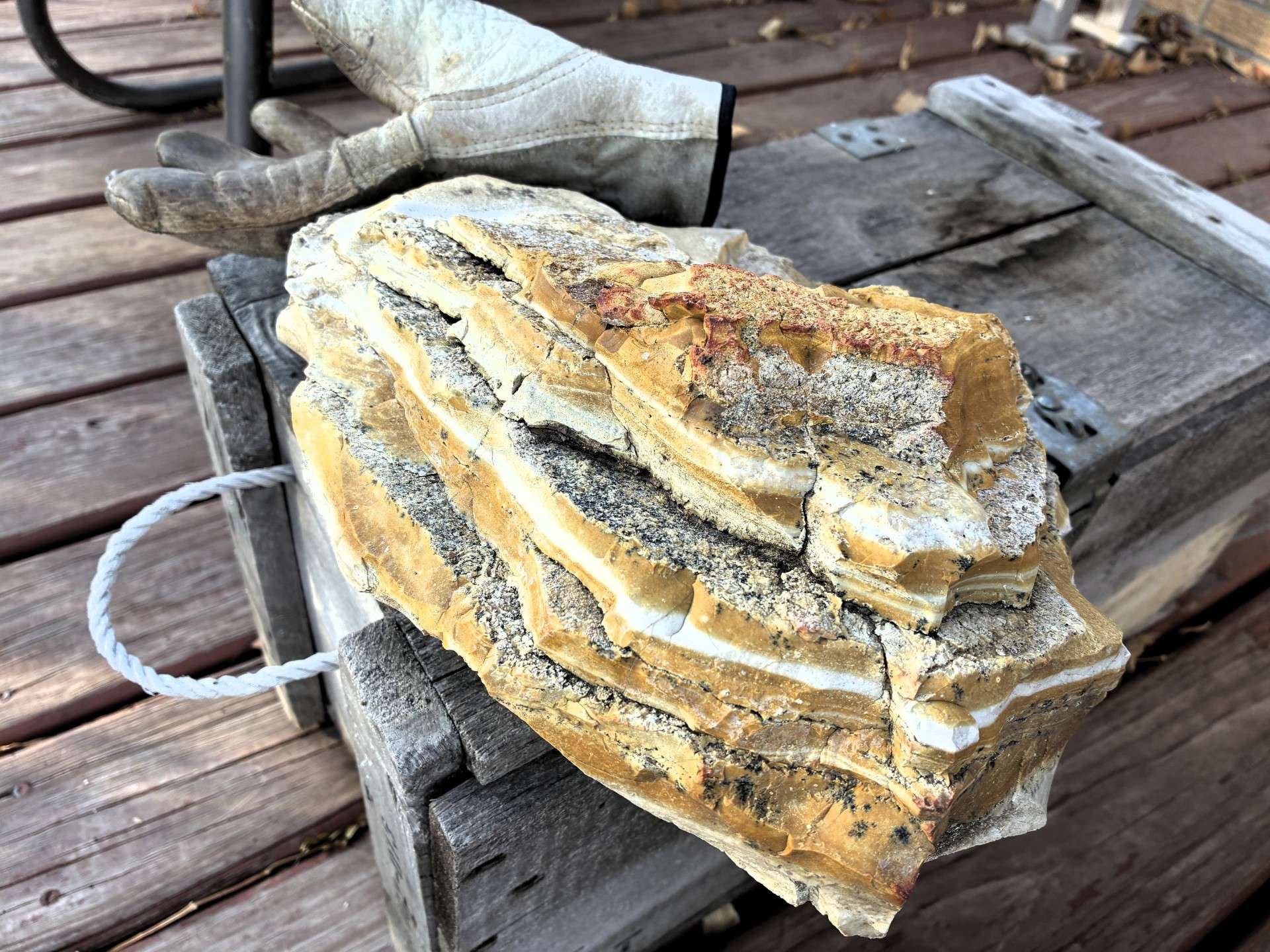
Anyone walking country roads or plowed fields in Northwest and North Central Kansas sees this frequently ochre-colored, silicified stone even if they don’t know its name. Researchers identified prehistoric quarries containing outcroppings of this desirable knapping material in Trego, Gove, and Graham Counties in Kansas and Fremont County Nebraska. So did those caches in Colorado and Wyoming contain tools made of stone quarried near my home?
According to research, Western Kansas sites produced desirable knapping material early hunters used for thousands of years. Oklahoma archeologists found artifacts made from it among mammoth and bison bones found during road, dam, and bridge work throughout their state.
This detail makes me wonder how many Pleistocene hunters wandered our region searching for game and resources to make tools. After all, the plains supported modern bison and native cultures who depended on them for survival. Why wouldn’t earlier people roast a mammoth haunch harvested with a spear head made of Smoky Hill jasper?
These nomads wandered from one watershed to another unconcerned about licenses, taxes, or land ownership. A decade ago, Dan Busse in Northeastern Colorado worked his field and noted fingernail-size bits of Smoky Hill jasper that weren’t native to his area. Investigating further, he dug up a hunter’s pack of fluted Clovis-style bifaces. Among them were several manufactured from Niobrara or Smoky Hill jasper, commonly found in western Kansas and Nebraska.
Add to this data details about KU professor Rolfe Mandel’s 2014 dig near Tuttle Creek. His team specifically searched for evidence of Clovis and pre-Clovis inhabitants in what is now Kansas. Lab analysts work to verify the findings.
Though few documented Clovis Cache finds exist in the U.S., research offers hope that any day now a Kansan could make a discovery like a landscaper in Boulder, Colorado, did. While working in his yard, he uncovered a stash of 80 artifacts used to butcher prehistoric camels and horses.
Though I doubt I’ll find such treasure, connecting archeological dots leads me to expect I’ll read about a Kansan who does in 2026.