


By ALIN HETT
Hays Post
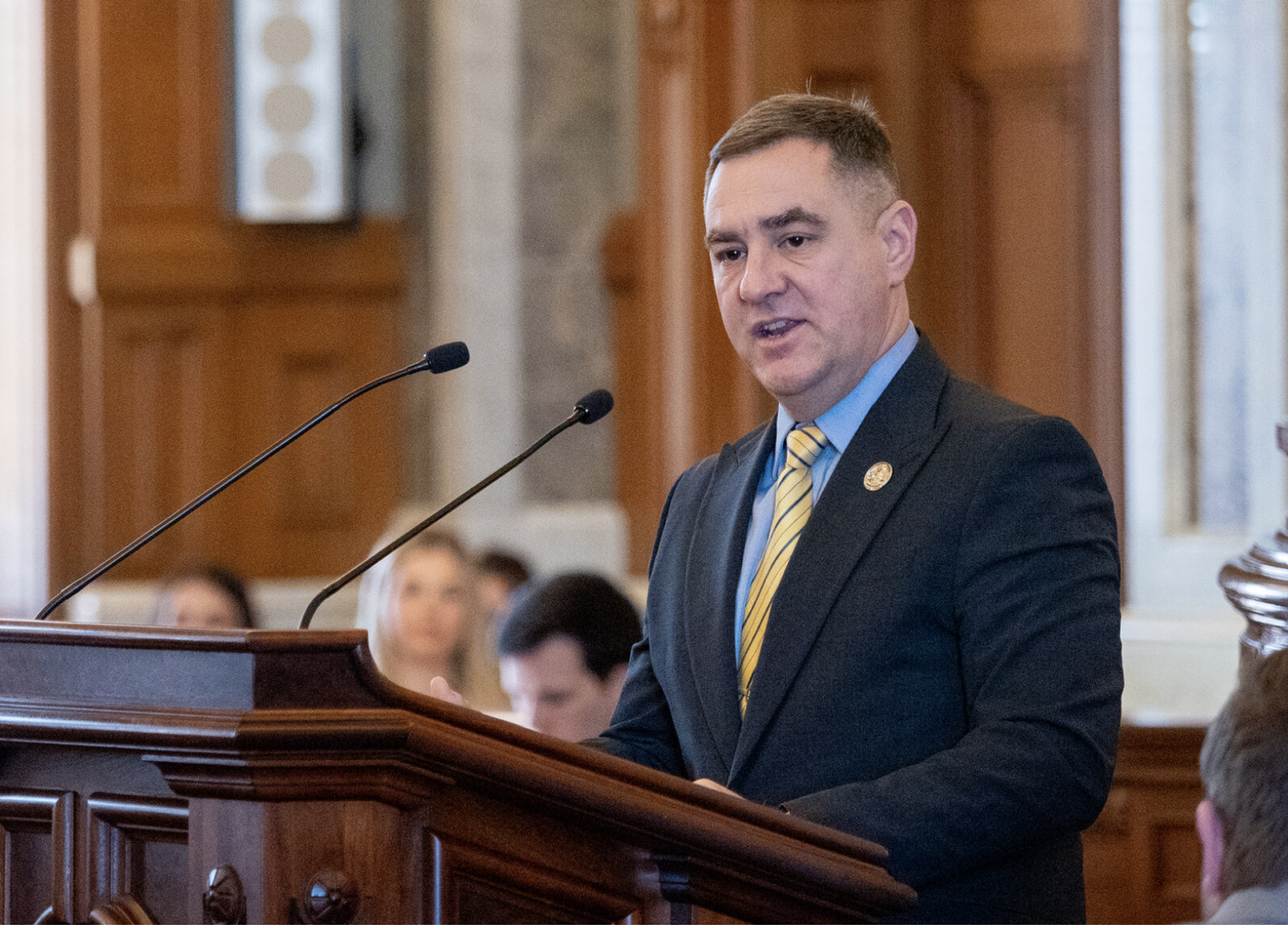
Pat Proctor, Republican nominee for Kansas Secretary of State, said restoring confidence in elections would be his central priority if voters elect him in November.
Proctor represents the 41st District, which includes Leavenworth, in the Kansas House. He has served in the Legislature since 2021 and leads the House Elections Committee.
“What I’ve tried to do as the chairman of the House Elections Committee, which I’m going to continue as secretary of state, if I have the honor to serve, is restore confidence in our elections,” Proctor said. “Trying to bring all those people who have lost confidence, who no longer believe that the results of our elections reflect the will of voters, back into the process.”
Proctor spent much of his childhood in Oklahoma. His family moved several times because his father worked for General Motors. He spent the last 20 years in Kansas.
His own career also took him across the country and overseas. Proctor served in the U.S. Army for 25 years, including deployments to Iraq and Afghanistan, before retiring as a colonel. He moved to Leavenworth in 2006.
Proctor said his military service shaped his view of elections and the importance of resolving political disagreements through civil institutions.
“What all those garden spots had in common is that people there didn’t believe in the ballot box to solve their problems,” he said. “They didn’t believe in civil processes. They didn’t believe in the rule of law.”
Those experiences, Proctor said, showed him the importance of preserving trust in American elections.
Proctor was elected to the Kansas House in November 2020. He has been chairman of the House Elections Committee for four years and said that experience has prepared him to oversee elections statewide.
His priorities as Secretary of State would include increasing transparency, addressing concerns about noncitizen voting and ballot collection, and maintaining the state’s voter registration rolls.
Proctor said election officials should listen to questions from voters, explain election procedures when concerns are based on misunderstandings and pursue changes when problems are identified.
“Every valid voter has their vote counted, and no invalid votes are counted,” he said. “I think that is the most nonpartisan thing in the world.”
Proctor said the secretary of state must administer elections impartially, even though candidates for the office run under political party labels.
“No matter which side of the aisle, we need to make sure that it’s an even playing field, and nobody is putting their thumb on the scale,” he said.
One of Proctor’s major legislative efforts involved eliminating Kansas’ three-day grace period for advance mail ballots.
Under the previous law, mail ballots postmarked by Election Day could be counted if they reached county election offices within the following three days. Proctor said he pursued the change for three years before lawmakers approved it in 2025 and overrode Gov. Laura Kelly’s veto.
Proctor said shifting vote totals after Election Day can weaken public confidence. He also pointed to ballots arriving during the grace period without postmarks, leaving county election officials unable to determine whether they were submitted before the deadline.
“The voter did everything right. The clerk did everything right,” Proctor said. “Because the post office didn’t put a little stamp on it, we still can’t count the vote.”
Kansas election officials reported that 2,110 of more than 1.3 million ballots counted in the 2024 general election arrived during the grace period, according to the Associated Press.
Supporters of eliminating the period argued that requiring ballots by Election Day would provide faster results and clearer deadlines. Opponents said the change could prevent ballots from being counted because of postal delays, particularly in rural communities.
The grace period remains in effect for the 2026 election after a district judge temporarily blocked the new law in July. The Kansas Supreme Court allowed that order to remain in place while the legal challenge proceeds, according to Kansas Reflector.
Proctor said he would continue supporting restrictions on third-party ballot collection, commonly called ballot harvesting. He said requirements such as ballot applications, signature verification and limits on how many ballots one person may deliver help ensure advance ballots are requested and completed by the registered voters to whom they were issued.
He also identified voter-roll maintenance as a priority. Proctor said the state should regularly review its registration records to identify people who have died, moved or otherwise become ineligible while protecting valid registrations.
Proctor said his work as elections chairman has given him experience evaluating election law, hearing concerns from county clerks and voters, and moving legislation through the House.
“Those are the things that I’ve been working on for six years as a legislator and on the Elections Committee, and for four years as the chair of the Elections Committee,” he said. “That’s exactly what I’m going to continue to do as secretary of state.”
Proctor faces Democratic nominee Jennifer Day in the Nov. 3 General Election. The winner will succeed Scott Schwab, who ran for governor but lost in the primary. The Secretary of State oversees Kansas elections and voter registration while also managing business filings and other state records.