


KU Medical Center
SALINA — Students from the University of Kansas School of Nursing-Salina got a firsthand look at the rewards and opportunities found in rural healthcare Oct. 2 when they toured two rural Kansas hospitals: Smith County Memorial Hospital in Smith Center and Rooks County Health Center in Plainville.
The tour was designed to introduce students to rural nursing practice and help them explore potential career paths in communities across northwest Kansas. Smith County Memorial Hospital and Rooks County Health Center are designated as critical access hospitals, with 16 and 22 beds, respectively. Students saw how both facilities maximize their resources and tailor their services to their communities.
At Smith County, students saw the medical-surgical unit, labor, delivery, recovery and postpartum unit, operating rooms and trauma bays as well as an attached rural outpatient health clinic, surgery center and skilled nursing facility. At Rooks County, students saw similar facilities as well as a large physical therapy, occupational therapy and pulmonary/cardiac rehabilitation clinic.
The hospitals shared insights into the vital role rural nurses play in providing quality healthcare close to home. Both hospitals are located in Dane G. Hansen Foundation service-area counties, which offer scholarship opportunities available to KU nursing students who commit to practicing in a Dane G. Hansen county after graduation.
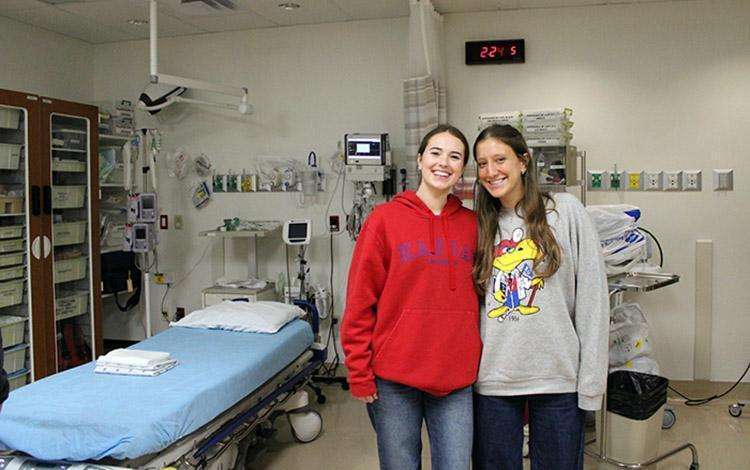
Below, two KU nursing students shared some of their thoughts about the tour. Emma Jones is a first-semester student from Tipton and Sarah Martinez Shaw is a first-semester student from Salina.

What was your perception of rural nursing before going on the tour? Did it change afterwards?
Jones: I have always had high regard for rural nursing because I grew up in a small rural community. I am incredibly proud of where I come from, and I have seen firsthand how important rural healthcare is to the people and communities it serves. Growing up in rural Kansas has given me a special appreciation for the nurses and healthcare professionals who dedicate their careers to caring for these communities. The tour didn't necessarily change my perspective on rural nursing, but it strengthened my appreciation for it.
One of my favorite parts of the experience was watching some of my classmates, who had never really experienced a community smaller than Salina, get to see what rural nursing looks like. I loved seeing them gain a better understanding of the many roles rural nurses take on and just how much these healthcare facilities mean to their communities.
Shaw: I enjoyed the tour so much! I have a degree in public health, which is what initially gave me an interest in rural healthcare. The interaction between people, policy and providers is so much closer and more personal in many cases than it is in more urban settings. My prior education emphasized the underserved aspect of rural health and lack of access. While that might be true in many respects, it also creates an image of rural hospitals as being basically triage centers.
I was surprised and so impressed by the technology, resources and the level of care these facilities provide for the people in their regions. It made me curious about the behind-the-scenes work that goes into developing those hospitals by administration to get that equipment, to get their staff trained so well and to get community buy-in for all of it.
What surprised you most about the rural facilities you toured?
Jones: What surprised me most about the facilities in Smith Center and Rooks County was how state-of-the-art they were and the variety of services they offered. I was especially impressed by the specialized services and access to specialists available in these smaller communities. I think people sometimes underestimate what rural hospitals are capable of providing, and it was wonderful to see how much these facilities are doing to bring quality healthcare closer to home for their patients.
Shaw: Probably my biggest surprise was realizing how much I would like to work in one of these hospitals someday.
What would you tell future students about going on the tour?
Jones: I would encourage every nursing student to go on the tour, even if they don't see themselves working in rural healthcare. It is such a great opportunity to step outside of what you are familiar with and see a different side of nursing.
Rural nurses often wear many hats, and I think there is so much to learn from the work they do and the relationships they build with their patients. Even if you plan to work in a larger city, gaining a better understanding of rural communities and the challenges they face will only make you a more well-rounded and compassionate nurse. I am a little biased because rural Kansas will always have a special place in my heart, but I truly think it is an experience every nursing student can benefit from!
Shaw: I would tell future students that the trip is a great way to bond with your classmates while getting a real-world experience with a medical setting that looks different than what we might expect, and to meet staff that genuinely love their work.