


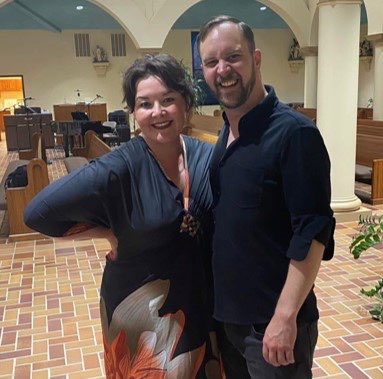
Submitted
Inside a rehearsal room at Hutchinson Correctional Facility, a group of men gather each week to sing — creating moments of connection, joy, and humanity in a place more often defined by isolation.
The setting is far removed from a traditional concert hall, but for choir director and Sterling area resident Katelyn Mattson, the purpose of the music remains the same: creating belonging.
“Being in a choir gives us a sense of belonging and community,” Mattson said. “These men have endured being judged on their worst day, but human beings are so multifaceted and complex. To be given the opportunity to leave their regrets at the door and make music together is so important.”
The Men’s Choir at Hutchinson Correctional Facility is supported through Arts Capacity, a nonprofit founded by violinist Holly Mulcahy, who resides in Chicago and serves as the Wichita Symphony Orchestra Concertmaster. The organization brings artists and live music into seven prisons across the country, including Hutchinson, to foster creativity, emotional resilience, and healing.
“Arts Capacity is built on the philosophy of helping people develop emotional connection, resilience, and creativity,” Mulcahy said. “It aims to re-humanize incarcerated populations as they prepare for reentry into society as future neighbors.”
During a recent concert inside the facility, Mulcahy performed solo violin pieces before the choir took the stage. She said the audience’s engagement surprised her immediately and challenged assumptions about incarcerated audiences.
“Their observations on Bach blew me away,” she said. “They noted the counterpoint, the multiple voices living on a single instrument, the seriousness, the complexities, and the simplicities — everything a trained musician would analyze.”
One especially powerful moment came during performances of two works titled “Notes From Lockdown,” one written by Mulcahy and the other by composer George S. Clinton.
“For this audience, they immediately recognized the anxiety, boredom, fear, and ultimate relief in the music — an emotional landscape they know all too well,” she said.
Then the men’s choir entered.
At the time of the concert, the ensemble consisted of six singers, though its size changes constantly due to transfers, court appearances, mental health struggles, and changing prison circumstances. Since that performance, the choir has doubled in size and now includes 12 members, reflecting growing interest in the program despite the challenges of maintaining participation within a correctional setting.
“Depression and isolation are common,” Mattson said. “In December our choir was more than twice that size, but the ensemble sounds fantastic.”
The group rehearses weekly and performs twice a year. Their repertoire ranges widely, from Schubert to Bono, and the men help choose the music and shape the arrangements.
“Very few choir members read music, but they have so much natural talent,” Mattson said. “Often times someone will throw in harmony based on what they hear and their instinct, so we add it in. Giving them full ownership makes the experience even more gratifying for them.”
For the latest concert, the choir requested “Lean on Me” and “There is Nothin’ Like a Dame” from South Pacific.
“One man shared that hearing ‘Lean on Me’ was exactly what he needed,” Mulcahy recalled.
Meanwhile, “There is Nothin’ Like a Dame” brought laughter throughout the room.
“There was a beat of silence at first,” Mulcahy said, “but Katelyn offered the translation of ‘dame’ and it absolutely brought the house down with laughter and a true sense of community.”
The concert also featured Alex Underwood, Hays High School vocal music director, who accompanied the choir and performed one of his own songs from his original musical Prince Hat Underground.
“I was so moved by their reaction to my song,” Underwood said. “Hearing them sing parts of it back to me and embrace the queerness of the character was really powerful for me.”
The program closed with a karaoke-style singalong of “My Girl,” with audience members stepping forward to take the microphone.
“Seeing the whole audience join in was pure joy,” Mulcahy said.
For Mattson, the concerts offer something many incarcerated individuals rarely experience: the chance to be seen as more than their circumstances.
“I think being witnessed is so, so important,” she said.