


By TONY GUERRERO
Hays Post
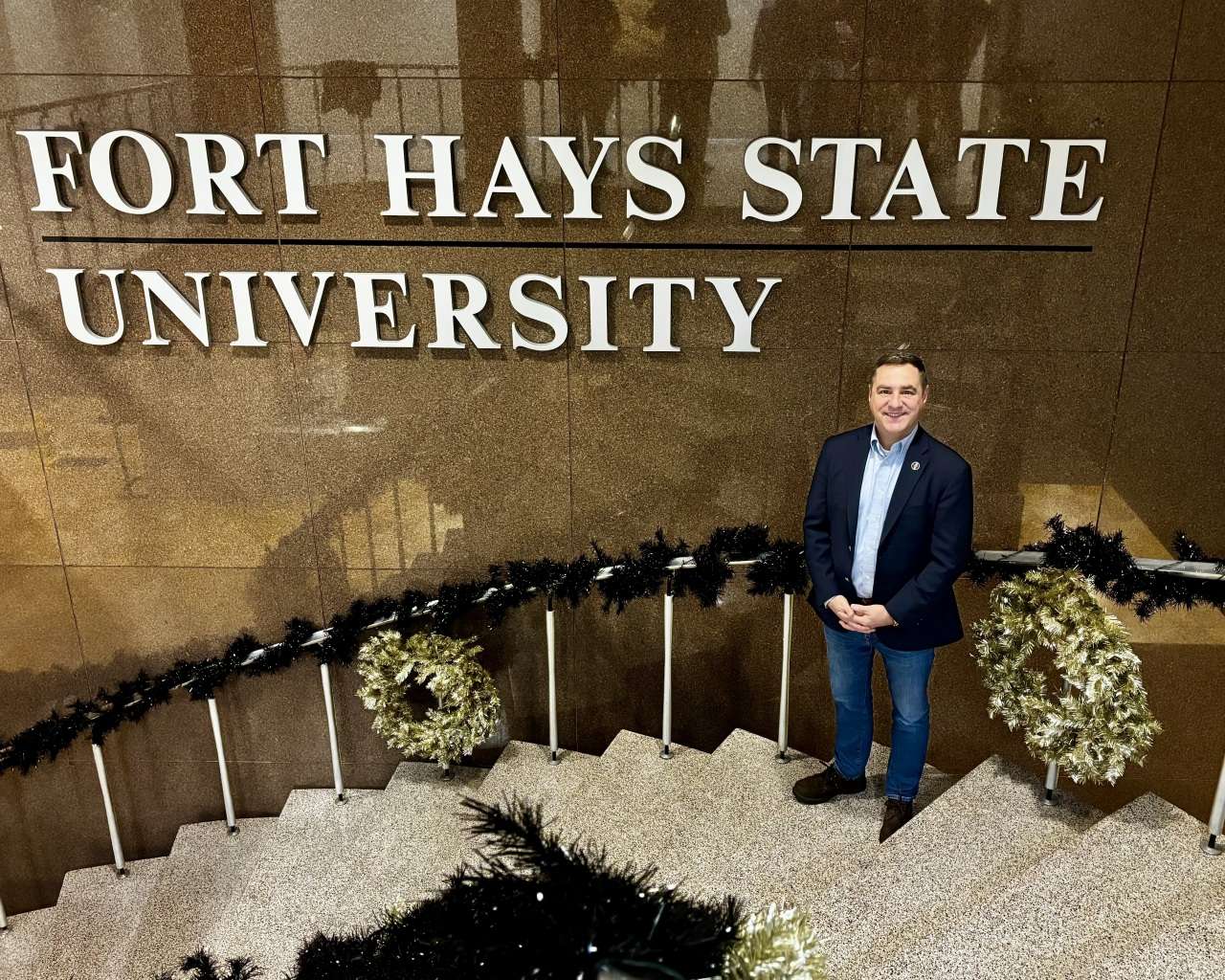
Rep. Pat Proctor, R-Leavenworth, 41st House District, was in Hays Tuesday to discuss his campaign for Kansas Secretary of State.
The Fort Hays State University College Republicans hosted Proctor, who aims to restore confidence in elections by promoting greater transparency, preventing noncitizens from voting, cleaning voter rolls and limiting ballot harvesting.
Proctor highlighted the end of the state’s three-day grace period for mail ballots. Starting in 2026, all ballots must be returned by 7 p.m. on Election Day.
"Sometimes somebody was winning on election night, and a few days later, somebody else is winning. That erodes confidence and transparency," he said.
An attendee raised concerns that ending the three-day grace period would reduce access for disabled and mail-in voters. Proctor responded that many ballots in the 2024 primary arrived without postmarks and could not be legally counted.
Proctor said he is working to add more early-voting days to compensate for the removal of the three-day grace period.
Proctor said noncitizen voting is a top concern he hears from Kansans. He cited the case of Joe Ceballos, a Kansas man charged with alleged election fraud after being elected mayor of Coldwater. Proctor labeled it a fixable problem.
Proctor said the DMV has, at times, registered noncitizens to vote. He said that last year the Kansas Secretary of State’s office obtained a list of noncitizens with driver’s licenses and identified about 80 on the voter rolls, with roughly 20 suspected of having cast ballots.
Proctor said Kansas now requires the DMV to regularly provide noncitizen lists to the state to clean voter rolls, following the passage of House Bill 2020 earlier this year. The Secretary of State cannot remove voters, but can direct county election officers to remove the names of noncitizens from voter rolls.
"Do I believe that there is a vast conspiracy for noncitizens to vote in the state of Kansas? No," he said. "The point is that we can tell people with confidence, no, we know noncitizens aren't voting because we're scrubbing the voter rolls."
Proctor said ballot harvesting is another threat to election integrity, especially in competitive districts like his own. He said left-leaning nonprofits target infrequent voters who would likely support Democratic candidates if they turned out to participate.
"They send them mail-in-ballot requests after mail-in ballot requests that are pre-filled out, so the voter just has to sign it, put it in the mail and they'll get a mail-in ballot. They keep sending it to them until they get sick of receiving them," Proctor said.
Proctor claimed in his district, during his first re-election, he won by a narrow margin and claims nonprofit ballot harvesting almost produced enough votes to cost him the race.
Proctor said nonprofit workers from outside Kansas come into the state to take part in ballot harvesting. He pointed to a law limiting individuals to submitting no more than 10 ballots that are not their own, but said he wants to pursue further changes to strengthen that restriction.
"I want to change the law so that you have to be a qualified Kansas elector to turn in a Kansas ballot because," he said. "The second thing is that right now on the ballot, the person who turns it in for somebody else has to sign. I want them to also have to put their driver's license number."
Proctor said with safeguards to conceal the license number, this step would allow officials to track who is submitting ballots and enforce the 10-ballot limit. He said he would restore a prosecutor and a law enforcement officer to the secretary of state’s office to support enforcement efforts.
Proctor also raised concerns about nonprofits that are not required to disclose their funding sources. He said money will always flow into politics and argued, rather than trying to restrict it through regulations, it should be fully exposed.
"I am for radical disclosure. I believe that whether you get one cent or $1 million from somebody, you should have to report it. It should be 100% transparent," he said.
Proctor said nonprofits campaigning for or against constitutional amendments could accept foreign money because of a loophole. He said this raises concerns not only about sovereignty but also about election integrity.
Proctor and his wife opened a restaurant in Leavenworth in 2006. He said after launching the business, he began receiving numerous notices about regulations he was not following or complying with.
"I'm of the mind that if the state puts a regulation on a business owner, it's the state's responsibility to make sure that the business owner knows the regulation. That's common sense to me," he said.
Proctor often saw businesses closing, buildings sitting vacant and families leaving his hometown. He hopes to make it easier to start a business if elected as Secretary of State.
Proctor spoke about his background and motivation for entering politics after serving 25 years in the army, including deployments to Iraq and Afghanistan.
He was elected to the Kansas House of Representatives in 2020 and now serves as chairman of both the House Elections Committee and the Joint Committee on Kansas Security. Proctor is also an assistant professor at Wichita State University, where he teaches courses on national security.