


By STACY CAMPBELL
Cottonwood Extension District
With the recent precipitation, producers may consider planting wheat back into freshly harvested summer crop residue.
While the current drought conditions offer significant challenges, there are additional considerations when seeding wheat immediately after the harvest of a summer crop. Some have been doing this for a while when the opportunity presents itself, while others might be considering it.
This article discusses several key management considerations to remember.
Variety Selection
If planting wheat after corn, adapted varieties with the best ratings for Fusarium head blight (scab) should be used. Due to moisture use by the previous summer crop, varieties with high levels of drought tolerance should be used. As wheat is generally planted later after a summer crop, varieties with good ratings for winter hardiness and late fall tillering should be selected. These ratings are available in the K-State publication MF991, Kansas Wheat Variety Guide 2026.
Planting Date
Wheat should be planted as soon as possible after harvest. Later planting dates shorten the window for forming fall tillers, which are more productive than spring-initiated tillers.
Seeding Rate: Seeding rates should be increased with delayed planting or in challenging high-residue environments where adequate stand establishment may be difficult. As previously mentioned, delayed planting reduces the opportunity to initiate fall tillers, and increasing seeding rates can overcome some of that reduction.
Harvest Considerations
Evenly spreading crop residue at harvest is a key action that can positively affect the productivity of the subsequent wheat crop. Uneven distribution of the summer crop residue can make it difficult to maintain adequate depth of seed placement. It can also result in uneven nutrient availability, as areas with higher crop residue are likely to immobilize more nitrogen.
Seeding Equipment and Seeding Depth
Seeding to adequate depth in high-residue conditions is necessary to ensure healthy crown development, maintain access to sufficient soil moisture in drying conditions, and reduce the potential for winter injury.
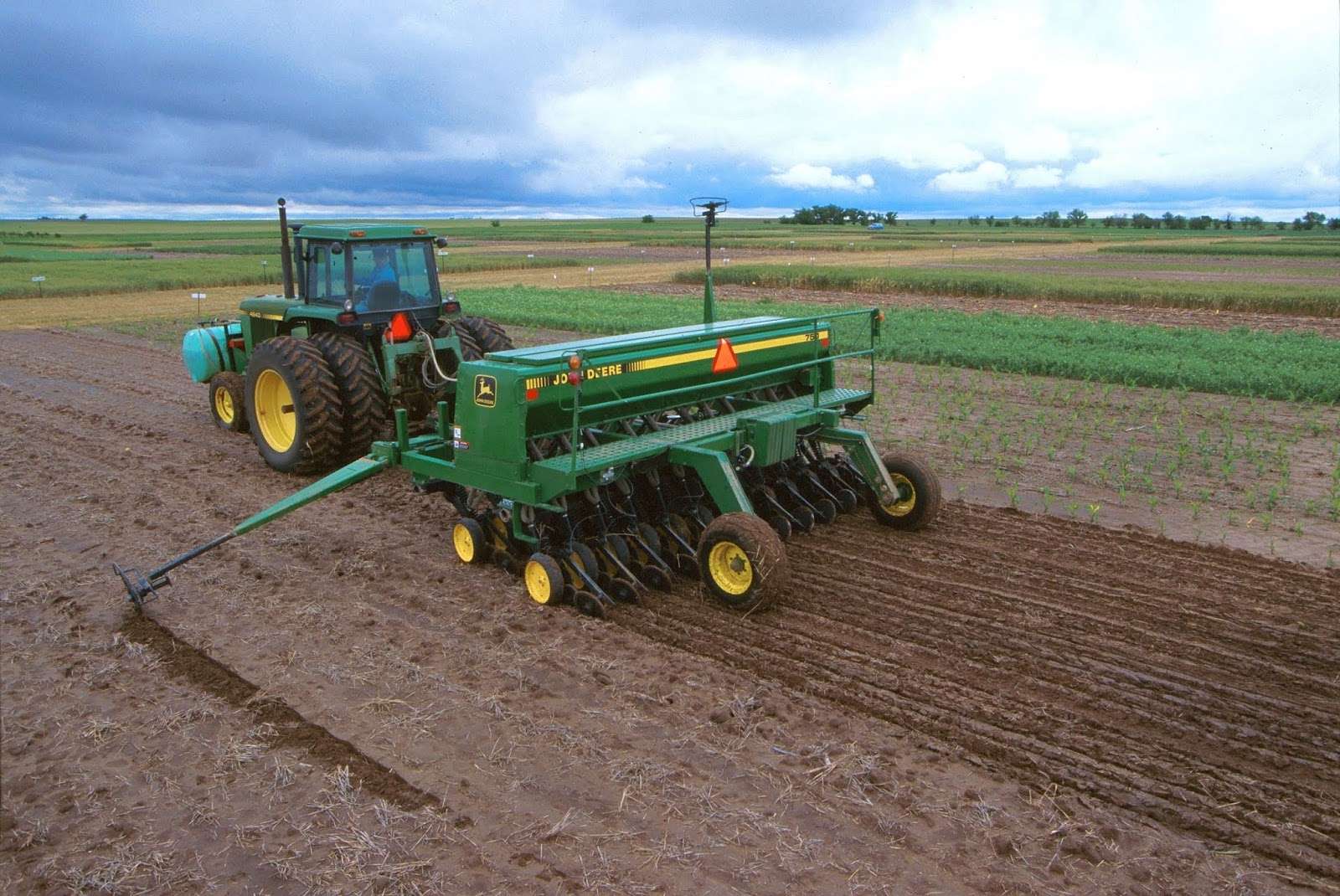
Producers should ensure their drill is set to achieve adequate depth in the thickest crop residue layers. Drills and air-seeders often require additional ballast (weight) to maintain adequate downforce to cut through residue and place seed at the target depth.
Producers should use ground speeds that maximize seeding performance. Often, increasing ground speed aids in the flow of residue through the seeding tool. However, increasing speed also increases the ballast and downforce requirements necessary to achieve the target seeding depth.
Nutrient Management
Generally, higher rates of fall-applied nitrogen are necessary for wheat when planted after corn or sorghum. This is especially true after sorghum, which generally has residue with lower nitrogen content, making it more likely to immobilize available nitrogen. An additional 30 lb./ac of Nitrogen should be applied to wheat following grain sorghum or sunflowers, compared with other crops.
Wheat planted after soybeans should not have its nitrogen application lowered relative to continuous wheat, as the organic nitrogen release from the soybean crop is likely to occur too late to benefit the wheat crop significantly.
Herbicide History
Producers should check the label of all products used in the preceding crop and their plant back restriction to wheat. Precipitation received since application can play a large role in the potential injury to the wheat crop from any residual herbicide.
Allelopathy
Planting wheat after sorghum is rarely done, but the potential effect of allelopathy of sorghum residue on wheat stand establishment and yield is often difficult to separate from nutrient availability and other potential yield-limiting factors. Concerns over allelopathy should not discourage producers from no-till planting wheat after grain sorghum when the aforementioned production concerns are addressed.
Stacy Campbell is a Crop Production Extension agent in the Cottonwood District (which includes Barton and Ellis counties) for K-State Extension. You can contact him by e-mail at scampbel@ksu.edu or by calling 785-628-9430.