


House-passed bill now in Senate creates educational program, elevates criminal penalty
By: Tim Carpenter
Kansas Reflector
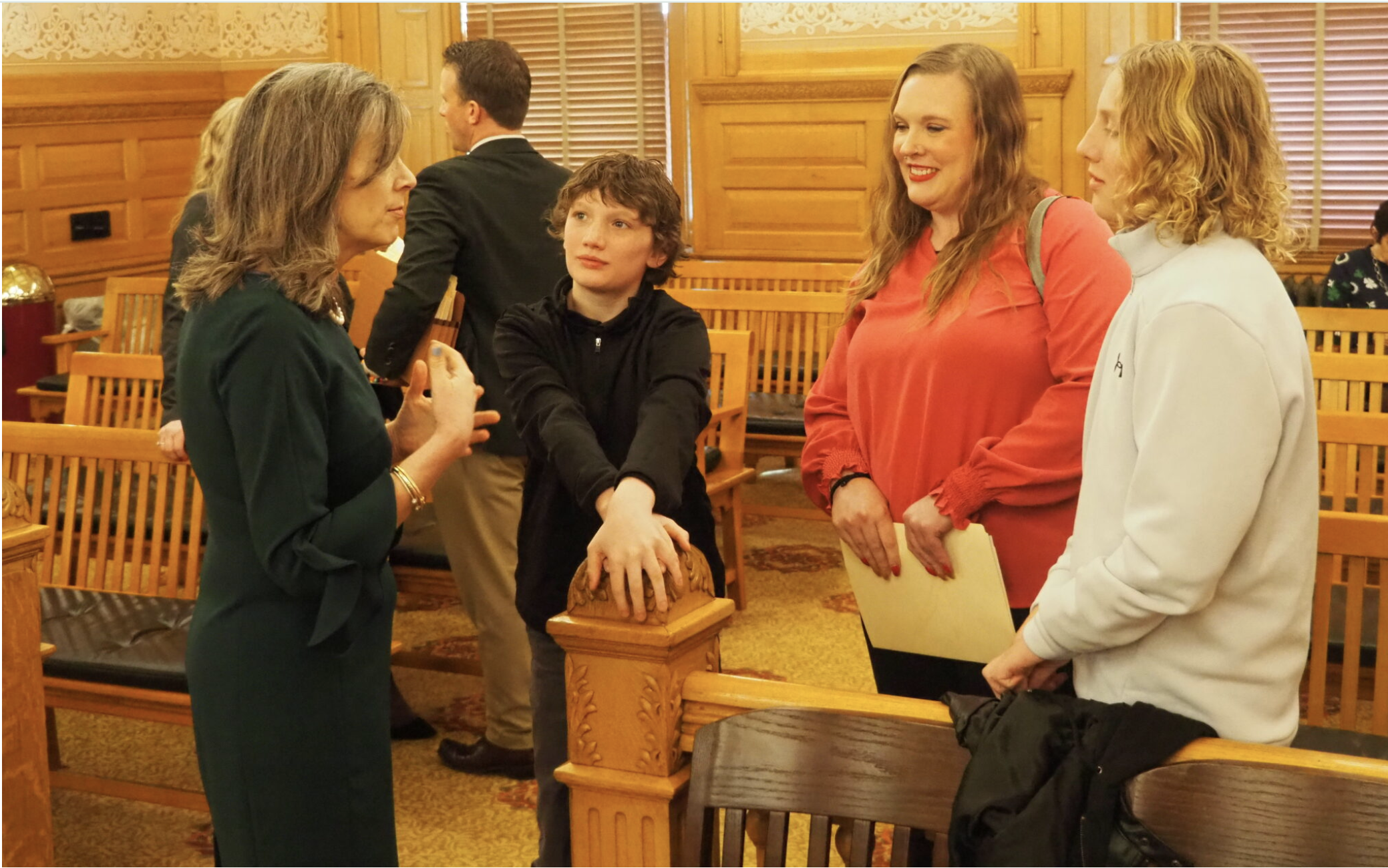
TOPEKA — Marcus Moore asked the Kansas Senate to pass legislation that might help other kids avoid what he described as the worst moment of his life.
In testimony to the Senate Judiciary Committee, Marcus described a routine June day hanging out with his 14-year-old brother, Caleb. They exercised with friends, went to football practice and played basketball. On the way home, Caleb talked to his younger sibling about friendship. In the house, Marcus grabbed some water. Caleb said he was going to take a nap. Another brother, Joshua, was at home with their sister.
“I heard a thud from upstairs,” Marcus said. “Then my 7-year-old sister came downstairs crying. Me and Josh rushed upstairs to the bathroom. That’s when we saw him laying on the ground. We ran to a neighbor’s house for help.”
El Dorado law enforcement officers and paramedics were quick to arrive on June 10, 2025, but Caleb had died by suicide.
Morgan Moore, the boys’ mother, said the family learned Caleb had been the victim of an internet tragedy known as sexual extortion, or “sextortion.” It involved individuals sending texts and emails to minors in a search for sexual images. The perpetrators pretend to be teenagers interested in making friends. If the recipient complies with an explicit image, the perpetrators threaten youths with public disclosure.
Moore said these cruel actors exploit everything vulnerable about children, including fear of disappointing parents, loss of social standing and the crippling of their future. She said the online attacks rely on a child’s undeveloped brain, their trust and curiosity, and an instinct to try to handle things alone. Perpetrators often demand money or additional images, and they tell victims to comply or, if they don’t want to cooperate, take their own life.
“These cases can escalate rapidly,” she said, “and the resulting trauma has led to severe psychological harm and, in some instances, suicide.”
Moore urged senators to approve House Bill 2537 — it would be known as Caleb’s Law — to create a state public education program to better prepare law enforcement, teachers, parents and students for the growing reality of sexual extortion. The state’s attorney general, in collaboration with educators, would oversee the program in Kansas public schools at an annual cost of approximately $200,000.
In addition, the bill unanimously approved by the Kansas House would increase the criminal penalty for sexual extortion when an offender was 18 years of age or older and the victim was under 18 or a dependent adult.
Gavin and Evan
Brandon Guffey, a state representative in South Carolina, and Brad Boettler, of Aurora, Missouri, offered testimony in support of HB 2537. Both were motivated by empathy for the Moore family, but also their own losses to suicide.
“On July 27 of 2022, prior to me taking office, I lost my 17-year-old son,” said Guffey, speaking of his son, Gavin. “We found out he was a victim of sextortion.”
Guffey said the person who allegedly coerced his son into sending nude photos was extradited in January from Nigeria to South Carolina for prosecution in U.S. District Court. The Nigerian is accused of posing as a young woman on social media and persuading Gavin to send compromising photos. He then purportedly sent messages that threatened to leak the photos and ruin Gavin’s reputation unless money was sent.
The state of South Carolina adopted Gavin’s Law to better educate the state’s children and adults about the evils of international exploitation and blackmail.
“While penalizing the crime is very important,” Guffey said, “90% of the battle is awareness. I firmly believe that if my son knew this was happening to many teens, and that he wasn’t alone and he was a victim of organized criminal networks, he would be with us today.”
Boettler spoke to Kansas senators about his 16-year-old son, Evan. He described the teen as an athlete and volunteer who was charismatic, respectful and kind. On Jan. 3, 2024, the world changed for the Boettler family.
“We received a text from Evan and seconds later a sound that told us our son had taken his own life,” Boettler said. “In the days that followed, one question consumed us: ‘Why?’ Then, on February 6, a message thread appeared that had not been visible before. It began with these words: ‘I have your pictures now. Are you ready to comply or I post and you get your life ruined in seconds?’ What followed was a stream of threats — demands for money, gift cards and passwords.”
Boettler told legislators this type of internet plague was occurring on internet social media platforms and in schools, churches and youth organizations.
“In Evan’s name, and through Evan’s voice, I respectfully ask (you) to act decisively and pass House Bill 2537,” he said. “If enacted, Kansas will move from a narrow statute to a comprehensive framework that reflects the true severity of this crime and provides accountability when children are harmed.”
Sara Hortenstine, chief of the youth services division in the attorney general’s office, said Attorney General Kris Kobach “fully supports these enhanced protections for Kansas’ most vulnerable individuals.”
Final words
Morgan Moore, who said she wasn’t familiar with the legislative process before seeking support for Caleb’s Law, said her son’s death reshaped the family.
She said there was a silence in their home where there used to be laughter. There was an empty seat where there should be a teenage boy “arguing with his brothers, raiding the fridge and planning his future,” she said.
“These predators use humiliation, threats and relentless escalation to trap children in fear,” she said. “They convince kids that if anyone finds out — parents, teachers, friends — their lives will be over. The goal is isolation. A child in that moment feels alone, panicked and terrified that asking for help will only make things worse. That is exactly where Caleb was. And that is why education is so important.”
Marcus, in remarks following those of his mother, said the bill should be signed into law so Kansas children know they could turn to a parent if someone threatened them.
“I’m hoping this law will teach kids to think before they send, to speak up if something happens, and that they are never alone,” he said. “Since losing Caleb, life has been hard. Things are a lot different and will never be the same. I would not wish this on my biggest enemy. It is the worst thing that could happen to anyone.”