


MIDDLETOWN, Iowa (AP) — The U.S. Army intentionally blew up the nation’s entire stockpile of lead azide at an ammunition plant in southeastern Iowa on Wednesday after officials said the 5 tons of degraded bomb-making materials were at risk of exploding uncontrollably as temperatures cooled.

The controlled detonation set off concerns about potential health and environmental impacts from lead dust, and frustration over a lack of information.
Video footage from several miles away showed two white plumes rolling over the detonation site before the clouds quickly dissipated. Journalists reported hearing a loud boom at the same time, around 9 a.m. Despite warnings to stay inside, some residents pulled to the side of a road to watch the blast upwind from the Iowa Army Ammunition Plant in Middletown.
Schools that weren't already closed for the Thanksgiving holiday canceled classes, and a gas station near the detonation site posted a note on the front door saying they'd be back open once it's safe. Some residents sealed their windows and doors as a precaution.
The blast originally was planned for last Friday. The Army changed the detonation date three times amid public backlash and to allow more time for safety measures and favorable wind, according to court documents.
The weather forecast around the time of the blast called for a gentle breeze to the southwest and temperatures around the freezing mark — one of the concerns has been that the stockpile will become volatile as temperatures drop.
“Inaction is no longer an option,” said Maj. Gen. Eric Shirley, the Army’s leader of the operation.
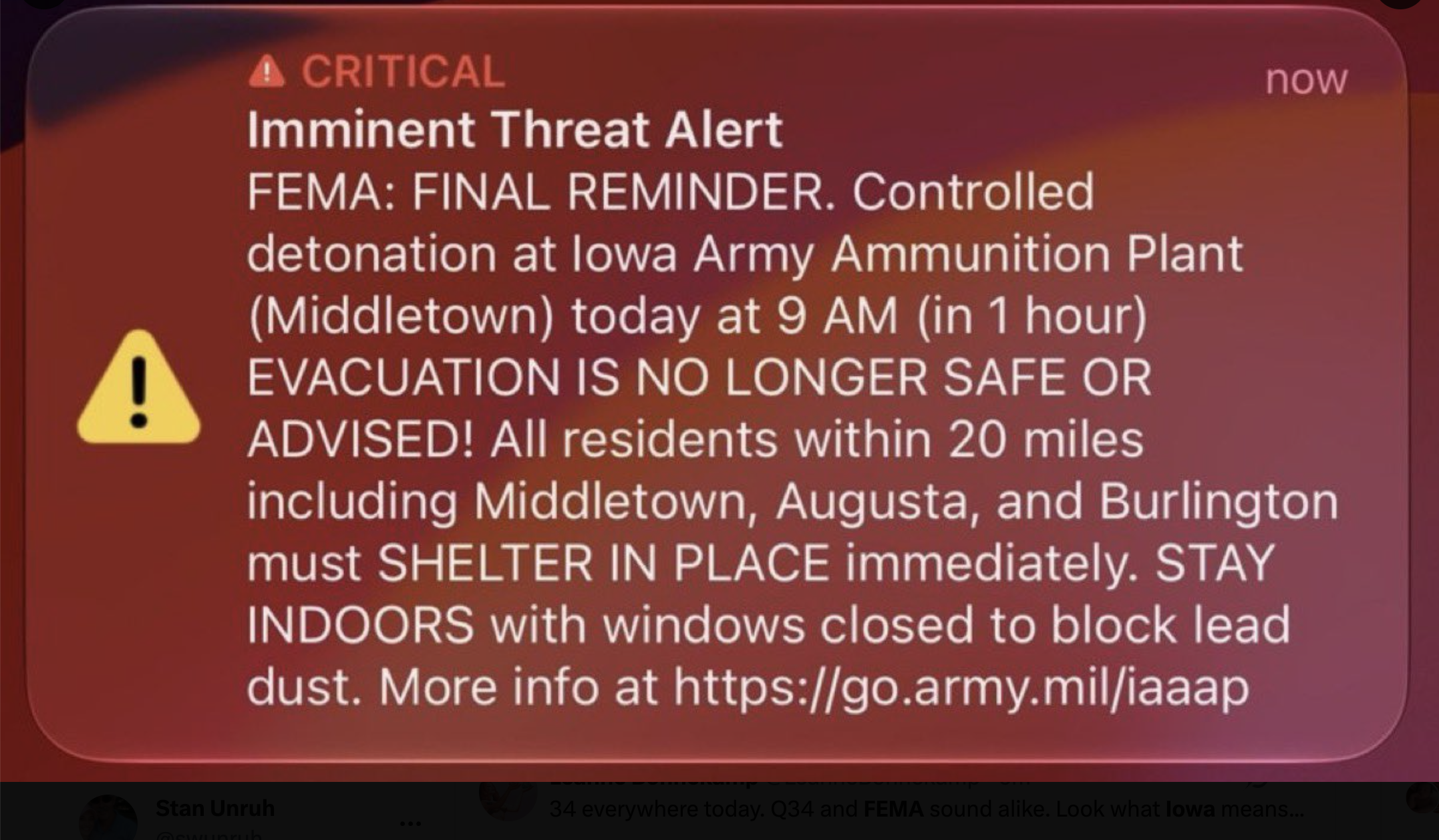
Government officials encouraged residents within 5 miles (8 kilometers) of the site to evacuate to avoid lead dust in the air, while also assuring them that barriers around the blast zone should limit much of the plume from the detonation.
Officials overseeing the detonation said the wind on Wednesday was expected to carry the plume southwest toward Missouri and away from nearby Burlington, a city of just under 25,000 people that sits along the Mississippi River.
But hundreds of homes and farms still could be in the path of a toxic dust cloud laced with lead — a metal that's not safe at any level and is especially dangerous to children and pregnant women.
The Army will take steps to quash the plume
Acting Secretary of the Army Adam Telle said the public should not panic.
The Army set up additional “blast barriers” around the bunkers where the 68 barrels of lead azide were detonated. The materials were surrounded by concrete and sand barriers two stories high.
Ballistic gels and foams were intended to absorb the lead dust, and the Army planed to douse the materials with more than 100,000 gallons of water to tamp down the plume.
A video of the site released by the Army showed the bunker encased by an earth berm and sand-filled blocks.
Decades-old lead azide was crystallizing, risking spontaneous detonation
The country’s stockpile of lead azide was brought to the Iowa location from bases around the country in 2009, according to Robert Cekada, director of the Bureau of Alcohol, Tobacco, Firearms and Explosives. The chemicals, used in munitions production, were stored in barrels in case the military needed to use them again.
During an inspection in March, staff at the ammunition plant found the lead azide had partially crystallized, making it sensitive to friction and cold temperatures and creating the risk of spontaneous detonation.
The Army assembled experts to formulate a plan, and they found that alternative solutions like thermal treatment and neutralizing the drums’ contents were not as safe as a controlled detonation.