


By:Sherman Smith and Morgan Chilson
Kansas Reflector
LAWRENCE — Attorneys will argue Friday in court over whether a judge should delay enforcement of a state law that invalidates driver’s licenses and birth certificates for those who changed their gender marker and restricts bathroom use based on sex assigned at birth.
Two trans men from Lawrence filed a lawsuit last week in Douglas County District Court to challenge Senate Bill 244, which took effect Feb. 26. The unnamed plaintiffs say the law violates constitutional rights to personal autonomy, privacy, equity, due process and expression, could subject them to harassment and violence, and would jeopardize their mental health and employment.
Attorneys with the American Civil Liberties Union and the Philadelphia-based Ballard Spahr law firm, which represent the plaintiffs, appeared by Zoom for a scheduling conference Tuesday in Douglas County District Court with Kansas Attorney General Kris Kobach and other attorneys for the state. Journalists from Kansas Reflector and the Kansas City Star and an attorney from the University of Kansas observed the hearing from an otherwise empty courtroom.
Douglas County District Judge James McCabria told attorneys they needed to find a time this week to hold oral arguments on a motion by plaintiffs for a temporary restraining order, which would block enforcement of the law. He set the hearing for Friday afternoon.
McCabria could rule quickly on the motion. He acknowledged a restraining order would be an “extraordinary remedy” for a law that has “broad application.” He noted the ruling would not be “a determination of final merits” in the case, and that he could continue to “weigh things later.”
The plaintiffs in the case are identified in court documents as Daniel Doe and Matthew Moe. During Tuesday’s hearing, the judge questioned Kobach about the use of pseudonyms. Kobach said it wasn’t typical but that he wouldn’t object, “just to make this thing move along.”
McCabria, who was appointed to the bench by Gov. Sam Brownback in 2014, said the use of pseudonyms “raises some questions,” and that he was concerned about the public’s right to know. He said he would wait until Friday to see if a news outlet objects to the plaintiffs’ request to proceed unnamed.
“I do see a reasonable and articulated reason for the request,” McCabria said.
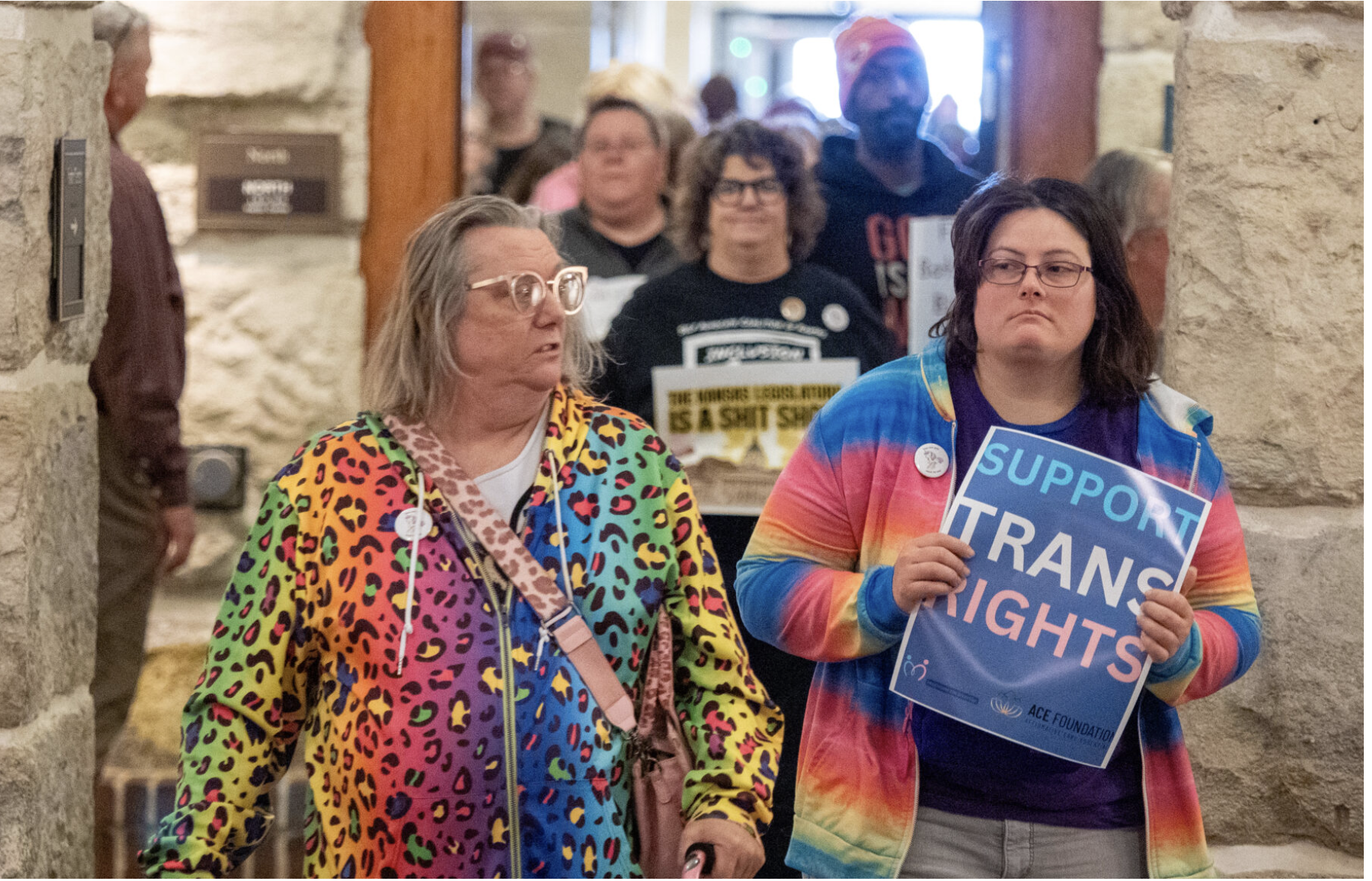
The GOP-led Legislature fast-tracked passage of the law this year while bending rules to avoid public input and silence debate. Every Republican except Emporia Rep. Mark Schreiber voted to pass the law and to override Democratic Gov. Laura Kelly’s veto, despite objections from Democrats about the cost to local governments, harm to transgender people, unclear provisions in the law, and constitutional problems.
Republicans argued, without evidence, that the bathroom provision of the law was necessary to ensure the safety of women. They ignored the reality that the law now requires trans men to use women’s facilities.
The law contains a bounty-style provision that allows individuals who feel “aggrieved” by someone’s bathroom use to sue the individuals for monetary gain. Any public entity that fails to properly police bathrooms could be subject to a $25,000 fine on first offense and $125,000 fines on subsequent offenses.
The Kansas Department of Revenue sent a letter to trans people shortly before the law took effect to inform them their driver’s licenses were invalid. However, independent journalist Marisa Kabas reported an internal KDOR memo to DMVs says no records have been invalidated.
The memo also says the agency sent a letter to 300 Kansans, although the agency has publicly said 1,700 records were affected.
Zach Denney, a KDOR spokesman, told Kansas Reflector that while the new law invalidates licenses immediately, agency employees must look at each record to determine why the gender marker was changed, as some could have been changed because of data entry errors. He encouraged individuals to check their status on the KDOR website.
“The KDOR driver’s license status check page accurately reflects KDOR’s internal system, and what law enforcement entities will see if they check a license,” he said. “The system is being updated, and as it is, the status check website will reflect changes made within the system.”