


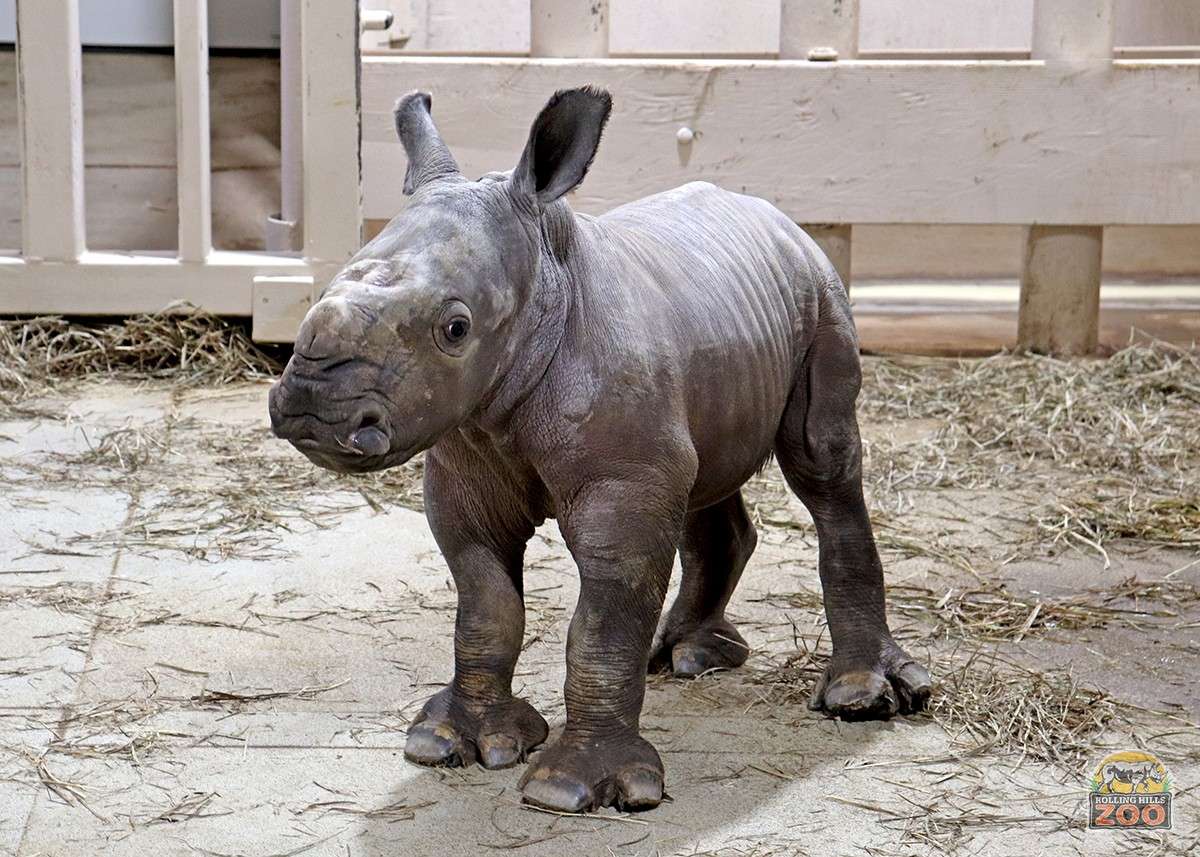
On Tuesday, Rolling Hills Zoo announce the birth of a male southern white rhinoceros calf on February 8, 2026. The calf and his mother, Evey, are doing well and bonding as animal care staff continue to monitor the pair from a respectful distance.
Evey, 19, and the calf’s father, Kengele, 27, were both previously part of a 15-member white rhino herd, known as a “crash,” at The Wilds Safari Park and Conservation Center in Cumberland, Ohio. Evey arrived at Rolling Hills Zoo in 2020, and Kengele joined the Zoo in 2024. White rhino gestation lasts approximately 16 to 18 months.
Evey and Kengele’s pairing was recommended by the Association of Zoos and Aquariums’ (AZA) Species Survival Plan? (SSP), a cooperative population management program designed to ensure the long-term sustainability and genetic health of species in accredited zoos. Rolling Hills Zoo is proud to be an AZA-accredited institution, the gold standard for zoos, and an active participant in this important conservation work.
At this time, the rhino barn is closed to public viewing. The Zoo asks for patience and understanding as Evey and her calf are given time to bond and adjust. Animal care staff are entering the building only as necessary, and the pair is being closely monitored via camera.
The southern white rhino is the second-largest land mammal after the elephant and represents one of conservation’s most remarkable comeback stories, having once been brought back from the brink of extinction. However, the species continues to face serious threats. A surge in poaching for rhino horn, particularly in South Africa, has led to record losses in recent years. As of 2025, the International Union for Conservation of Nature (IUCN) reported a 9.8% decrease in white rhino populations, bringing the global estimate to approximately 15,752 individuals in protected areas. The species is currently classified as Near Threatened.
“This birth is not only a joyful milestone for Rolling Hills Zoo, but also an important contribution to the conservation of this incredible species,” said Mark Echevarria, RHZ Curator. “Every calf born under AZA’s Species Survival Plan represents hope for the future of white rhinos and long-term sustainability of the animals within AZA facilities, while also maintaining their genetic diversity. Rolling Hills Zoo is very proud to be a part of and contributing to that mission.”
Rolling Hills Zoo will share updates, photos, and eventual public viewing information on its website and social media channels as the calf continues to grow and thrive.