


The wins: Chiefs deal, stable budget, tax cuts, education funding and ‘civility’
By:Tim Carpenter
Kansas Reflector
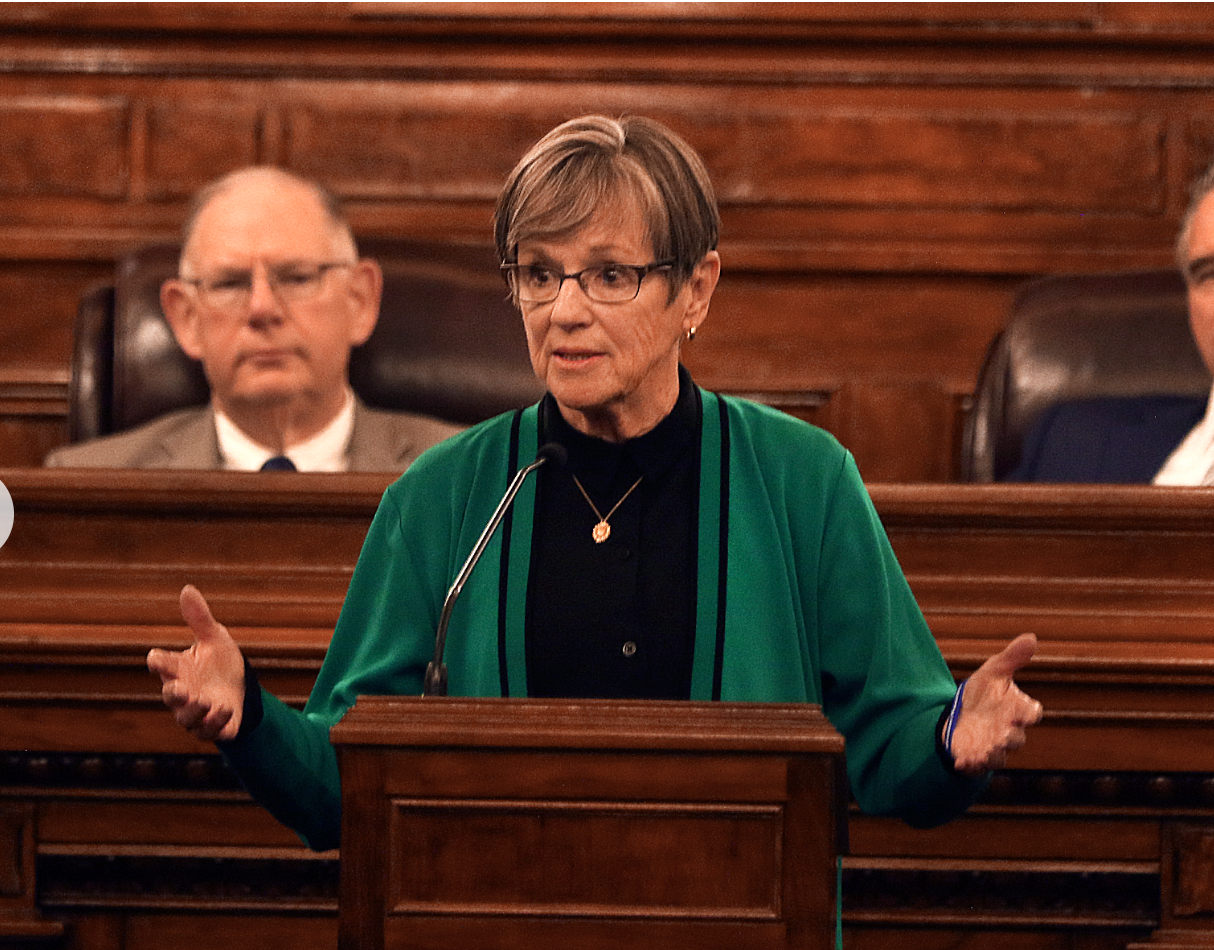
TOPEKA — Gov. Laura Kelly says Kansans wouldn’t have elected her if she were the type of politician who screamed the loudest and relied on bullying others to get her way.
She said during her annual State of the State speech Tuesday night it was a certainty Kansas would have suffered in terms of managing the government, advancing economic activity and elevating the quality of life if voters had chosen a governor who confused toxicity for leadership.
“I’m here because Kansans were looking for someone who would turn the volume down, to do more listening than yelling, to bring people together, to compromise and govern from the middle,” Kelly told the joint session of the House and Senate. “Kansans are the most civil, decent people on earth. And they expect that from us, too. I say to everyone here — do not let the loudest voices, on either extreme, drown out the voices of the vast majority of Kansans who want to see us work together.”
Kelly said placing cooperation ahead of partisanship and having the courage to treat colleagues with respect was key to finding common ground among politicians with different ideologies and backgrounds. She said this form of leadership led to enactment of 587 bipartisan bills in her seven years as governor. It created an environment where cross-party dialogue could produce an economic incentive deal for construction of a stadium in Wyandotte County to host the Kansas City Chiefs.
“To land the Chiefs, we all put politics aside,” the Democratic governor said. “We all put personal differences aside. And we didn’t care who got the credit.”
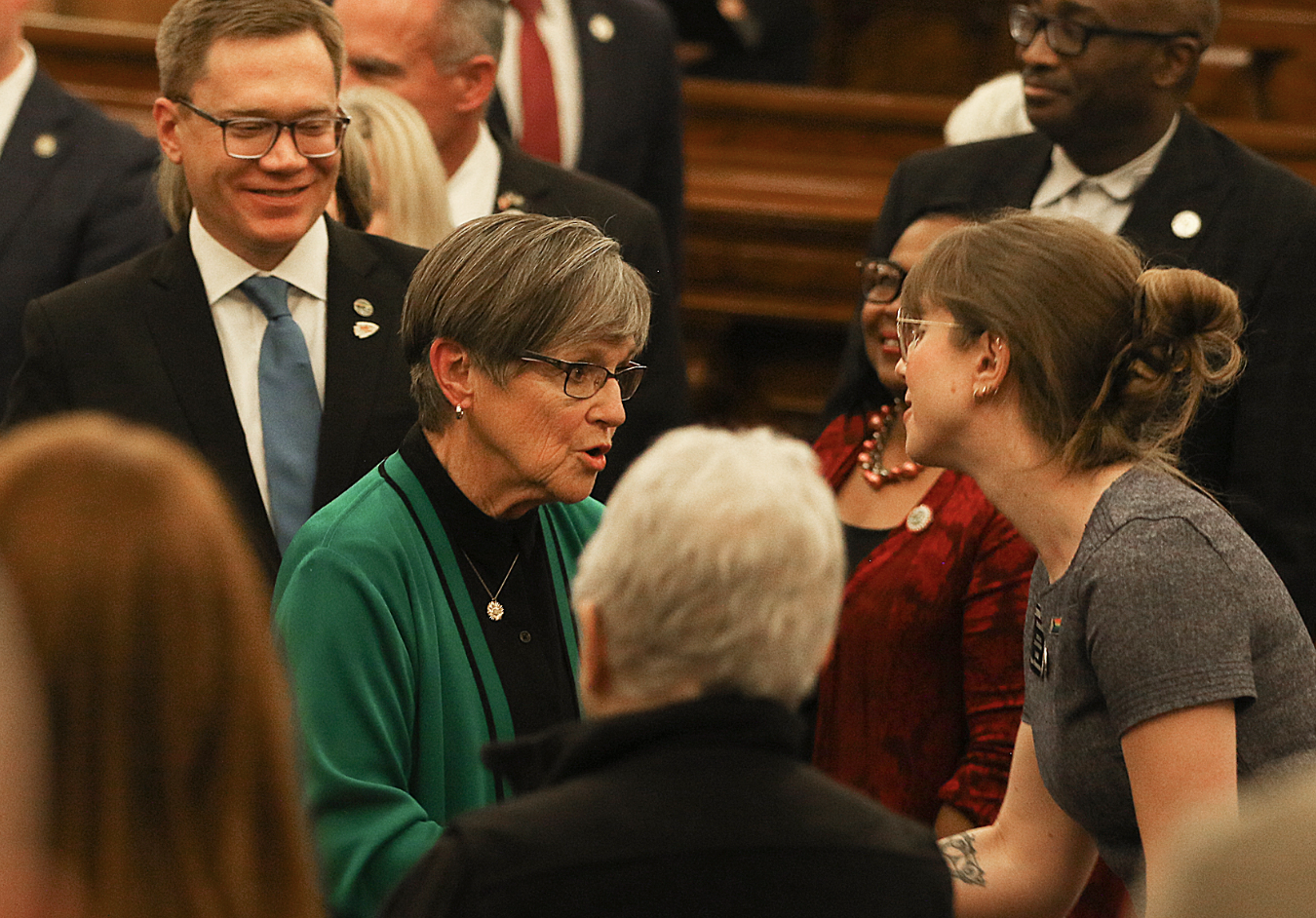
She said the core of this mostly collegial relationship was borne through years in which Kansas overcame major challenges. She said the state moved away from an era of budgeting woes marked by “gimmicks and funny money,” underfunding of K-12 schools, crumbling bridges and highways, a quality of life that fed a youth brain drain and missed opportunities for job growth.
The perception of Kansas was transformed by attracting more than $30 billion in business investment and the creation of 80,000 good-paying jobs since 2019, Kelly said. The state slashed annual taxes by more than $1 billion, including elimination of the unpopular $500 million state sales tax on groceries. The balance in the state’s rainy-day fund mushroomed to $2 billion. High-speed internet was provided to 117,000 homes and businesses. Kansas paid down debt. The state’s crime rate fell to a 20-year low.
“I know there is more to do,” Kelly told the GOP-dominated House and Senate. “But after seven years, I also know that the state of our state has never been stronger. Ultimately, we were able to get our state back on track because we showed that civility can still exist in our politics, that you can get a whole lot done when you work with others.”
Kelly, a term-limited governor who leaves office in January, said this moment in Kansas politics shouldn’t be taken for granted.
“There are too many forces trying to push us all into our partisan corners and make the other party the enemy,” Kelly said. “Let me state the obvious. We live in extraordinarily challenging times. And I don’t just mean our politics.”
Kelly said societal change in the past decade was head-spinning. People found themselves more attached to telephones and other electronic devices than ever before. The world crashed into the COVID-19 pandemic. People emerged from the other side to more remote work, AI bots and self-driving vehicles that made people yearn for simpler times, Kelly said. An era defined by disruption required more, not less, from political leaders, she said.
Kansans demonstrated at the ballot box they yearned for leaders who could offer strength, resolve, character and a clear vision, Kelly said. She said the United States received the opposite at the national level in Washington, D.C.
“From both parties,” Kelly said. “Where it became acceptable for our nation’s leaders to treat one another in the most uncivilized ways imaginable. Language and behavior we’d never tolerate from our own children. Instead of using this new technology to reach people with messages of unity and hope, these devices have been turned into weapons for elected leaders to ignite chaos and anger and even violence.”
“Instead of representing their communities, elected officials turned into foot soldiers for their political parties — firing off insults and vitriol to score likes or follows or wins for their team — instead of doing what’s right for their constituents,” Kelly added. “It’s as if they checked their free will at the door and just did as they were told. Treating their own colleagues in such angry and dehumanizing ways, just because they’re in the other party. And the most frightening part — it’s now become the new normal.”
She said the better alternative was to model political discourse evident in Kansas, where politicians could engage in civil exchanges and, at times, acknowledge folks in the other political party had good ideas.
She said that same attitude would be useful in the 2026 session of the Legislature, which began Monday.
Kelly said the state should fully fund K-12 public education and increase the state’s investment in special education. To fill a funding gap ignored by Congress, she said Kansas had provided $120 million for students in special education. Kelly’s proposed budget for the upcoming fiscal year would continue to increase state investment in disabled and gifted students in public schools.
She said Kansas also ought to provide sufficient funding to cover the cost of reduced-price meals in schools to ease financial stress on families.
“We know with grocery costs being what they are right now, that for many of these families, even that reduced cost is untenable,” Kelly said. “Let’s make it clear: No child in Kansas should ever have to worry about having enough to eat. Life is hard enough for our children these days.”
Kelly endorsed a bipartisan Kansas Senate bill that would ban cellphone use by students during the school day. The “bell-to-bell” ban in public and private schools could be implemented in the 2026-2027 school year.
She said Kansas had taken strides to improve services to people challenged by mental illness, but the Legislature should do more to increase treatment beds, hire more treatment professionals and to broaden the crisis response network.
The governor urged the Legislature to dedicate themselves to crafting a comprehensive, long-term strategy for advancing reform in water policy. The state needed a stable funding source for programs aimed at improving the supply and quality of water statewide, she said. The majority of water used in Kansas goes to irrigating crops, which invites political turmoil when changes were proposed.
“I know it is a very sensitive political issue,” Kelly told lawmakers. “But the future of our entire state is dependent upon the actions we take today. It will require looking beyond the next election and looking instead to the next generation.”