


Contender Vicki Schmidt skips debate to protest mandatory $10,000 payment to state party
By: Tim Carpenter
Kansas Reflector
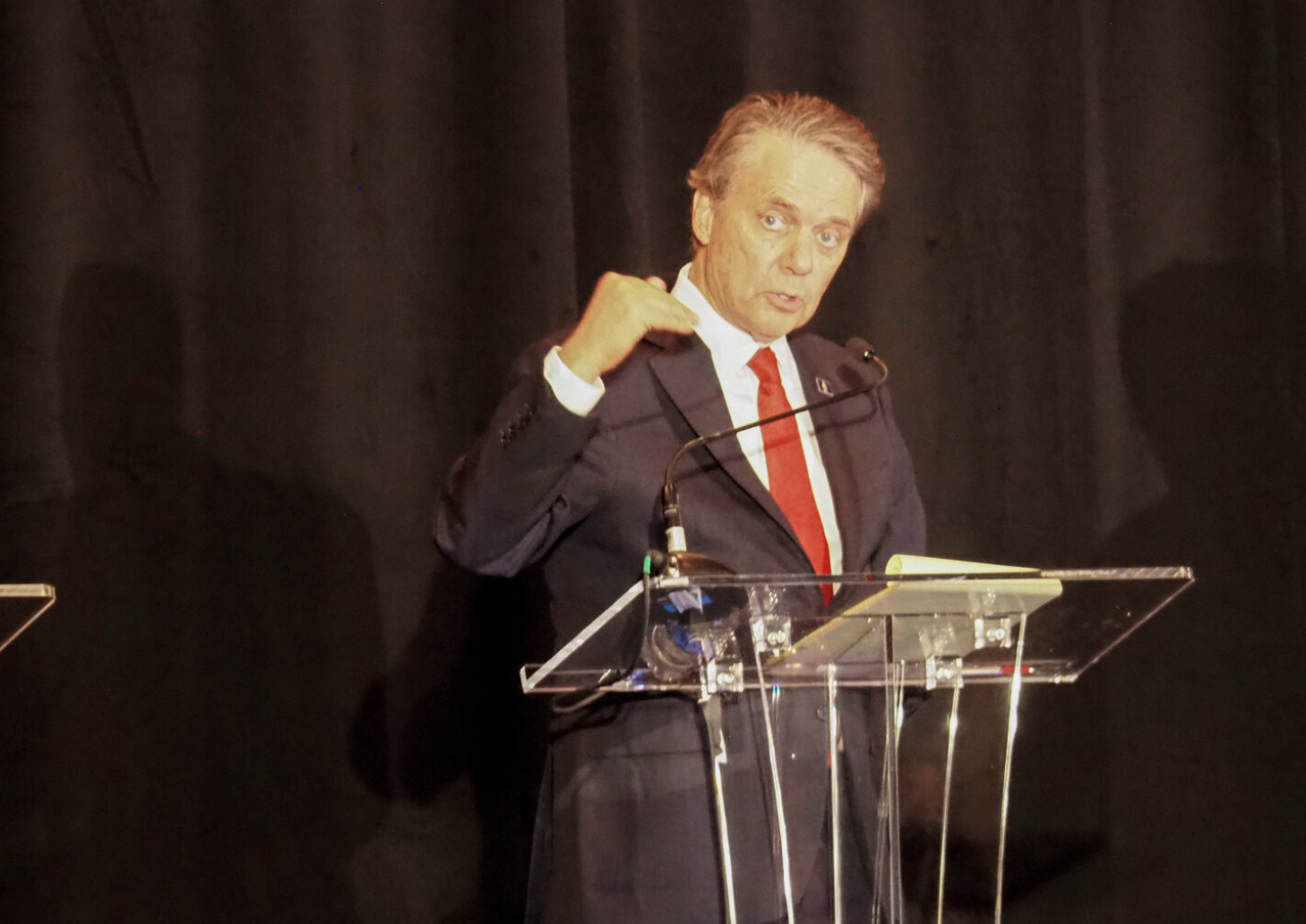
WICHITA — Six Republican candidates for Kansas governor stepped onto the debate stage Friday intent on finding separation from their rivals despite unanimity on key issues of abortion, marijuana, judicial bias and praise for President Donald Trump.
The goal of offering voters a distinct vision of themselves at the event sponsored by the Kansas Republican Party surfaced quickly as Charlotte O’Hara, a former Johnson County commissioner and Kansas House member, launched into an opening statement that sought to undercut a couple of her peers.
“We’re going to have some real difficult discussions this evening because Kansas has a real problem, within the Republican Party, of a vast sea of RINOs masquerading as Republicans,” said O’Hara, who directly chastised Insurance Commissioner Vicki Schmidt and Senate President Ty Masterson for being too chummy with Democrats.
Masterson, an Andover Republican, said O’Hara’s broadside against fellow Republicans had been shown to be toxic for voters.
“That type of thing is why we lose in the general election. We spend time cutting each other off at the legs,” he said, glancing at the other GOP candidates. “This is not the enemy. The Democrats are the enemy.”
Philip Sarnecki, a financial services executive who has never before run for elected office, picked up the attack thread by noting Trump carried Kansas three times by double-digits in the same era that Kansans twice elected Democratic Gov. Laura Kelly. Without naming names, he criticized longstanding politicians next to him, including former Gov. Jeff Colyer, Secretary of State Scott Schwab and Masterson. He apparently wasn’t referring to Joy Eakins, who only has won election to the Wichita school board.
“Career politicians are failing us,” Sarnecki said. “I am tired of watching Republicans lose in Kansas. No more losing. It’s time to start winning again, and that’s why I’m running for governor.”
Eakins jumped into the fray by declaring that veteran politicians in Kansas were undermining the American dream. She said the state’s established politicians “have been stewarding our decline. You see it everywhere.”
Colyer, who was lieutenant governor to Gov. Sam Brownback before assuming the top job for one year, said he didn’t appreciate the notion experience working as the state’s chief executive was a handicap.
“Kansas needs a proven, strong, competent conservative governor who will fight for you and who will stand shoulder to shoulder with President Trump,” Colyer said. “This is about winning. This is about taking back our state so that we are the beating heart of America once again.”
Schwab, who struggled with a health issue that weakened his speaking voice, said he grew as a leader by working as secretary of state and serving in the Kansas House.
“Having experience to understand the terrain has always been a plus in America,” he said. “They call be a career politician, but no one’s insulting my integrity.”
Absent from the GOP debate was Schmidt, the state’s insurance commissioner. In a letter to GOP officials, Schmidt said she strongly opposed the state party’s $10,000 “pay-to-play” requirement for candidates who wanted to participate in the debate. She said the Republican Party should remain neutral during the primary campaign and that every GOP candidate for office ought to have equal opportunities to share their views at party-sanctioned events.
“Under this agreement, the party picks winners and losers,” Schmidt said. “President Trump has brought new voters to the party and we need to be encouraging good folks to run for office as Republicans, not creating road blocks and challenges that discourage them.”
Despite a bit of theatrical elbowing on the stage, the six candidates found harmony on the goal of reducing the number of abortions performed at Kansas clinics, rejecting legalization of medicinal or recreational marijuana in Kansas and endorsing a proposed amendment to the Kansas Constitution — on the August ballot — that would require justices of the Kansas Supreme Court to be elected by popular vote.
In 2024, the state reported more than 19,000 abortions due to an influx of women from states that essentially banned the procedure. The state Supreme Court issued an opinion in 2019 that said a foundational right in the Kansas Constitution to bodily autonomy granted women the ability to decide whether to end a pregnancy. Despite the U.S. Supreme Court’s reversal of Roe v. Wade in 2022, abortion has remained legal in Kansas.
Colyer said at the current rate of growth in abortions in Kansas, there would be more abortions reported than live births in the state by 2030.
“How do we defend innocent life? I think this is one of the civil rights issues of our time,” Colyer said. “We have a Supreme Court that has found this right to abortion that is nowhere found in that constitution. It’s our fastest-growing industry in the state of Kansas.”
In lockstep, each of the other candidates — Schwab, Masterson, Eakins, Sarnecki and O’Hara — outlined their revulsion with Kansas’ status as an abortion destination state.
“It is frustration that the court hates its Legislature,” Schwab said. “That’s unholy. I feel horrible that a young woman can be manipulated to have an abortion, and there’s no recourse.”
The candidates had a lively conversation about marijuana use that at times appeared to clash with scientific reality.
Eakins, a businesswoman who was on the school board in Wichita, said she didn’t want high school students thinking about where to score a joint rather than focusing on their reading and math test scores. Where marijuana had been legalized, she said, states collected $1 in taxes for every $4 expended to deal with health problems resulting from pot.
“It creates all kinds of problems inside a culture that then need services,” she said. “I’ve watched families raise there children in states with this legalized marijuana … and all of them had struggles.”
Sarnecki, who said he’d never tried marijuana, said he opposed legalization because chemicals in the product would lead to a swift dumbing down of the nation. He said the active ingredient in pot these days was much higher than what was in the 1970s or 1980s.
“This is not you mom and dad’s marijuana,” he said. “Marijuana is a gateway drug. It creates massive problems — hallucinations, schizophrenia, massive anxiety.”
Masterson, who controls the Kansas Senate debate calendar, said he wouldn’t welcome legislation to legalize marijuana in Kansas, but he endorsed Trump’s decision to open the door to research on marijuana because pot was pervasive in the United States. He predicted research would demonstrate it was “damaging.”
All six candidates threw their weight behind the proposed constitutional amendment to transform how Kansas Supreme Court justices were placed on the high court. Currently, applicants for openings were interviewed by a committee that included a majority of attorneys. The committee forwarded up to three finalists to the state’s governor, who selected a person to fill the vacancy.
The amendment would eliminate that merit-selection process and replace it with statewide elections for justices. Other states that have chosen this method fostered a wild political atmosphere in which millions of dollars were spent on elections.
O’Hara, the former Johnson County commissioner, said the current process was dominated by the Kansas Bar Association. It resulted in appointment of justices who forced the state to increase spending on K-12 education and found a loophole in the constitution to keep abortion legal.
“We have to have direct elections of our justices,” she said. “It needs to be a partisan election. We have to stop allowing the Kansas Bar Association control our life through their erroneous judicial decisions.”
Danedri Herbert, chairwoman of the state Republican Party, told about 500 people gathered for the debate the primary election result wouldn’t satisfy everyone in the room. She urged Republicans to come together in November to defeat the Democratic Party’s choice.
“The one that walks away with the crown may not be your favorite,” she said. “At the end of it, we still want all of you on board because when all Republicans are united, we win.”
The dust in what could be a boisterous campaign for the Republican nomination won’t settle until votes are counted in Aug. 4 election in Kansas.
Johanna Warshaw, a spokeswoman for the Democratic Governors Association, said the “crowded, messy race to the right where attacks are already flying and candidates are staking out the most extreme positions” was on display at the Wichita Marriott. She asserted the Kansas GOP’s potential candidates to replace Kelly had aligned themselves with the Trump administration.
“The GOP candidates running for governor have all embraced the administration’s unpopular, cost-raising agenda,” Warshaw said.